Yuva Sathi Eligibility Criteria 2026: 6 Rules, Who Was Left Out & 8 Rejection Reasons
Last updated: 26 October 2026. Lakhs of young people applied for Banglar Yuva Sathi in February 2026, but not all of them were approved. Many are still trying to understand the Yuva Sathi eligibility criteria and why their status shows “pending” or “rejected”.
This guide explains each rule straight from the official notification, in simple words. You will find the exact birth date range, the groups that were left out, the 8 most common rejection reasons and what you can do now that the new Yuva Shakti scheme is on the way.
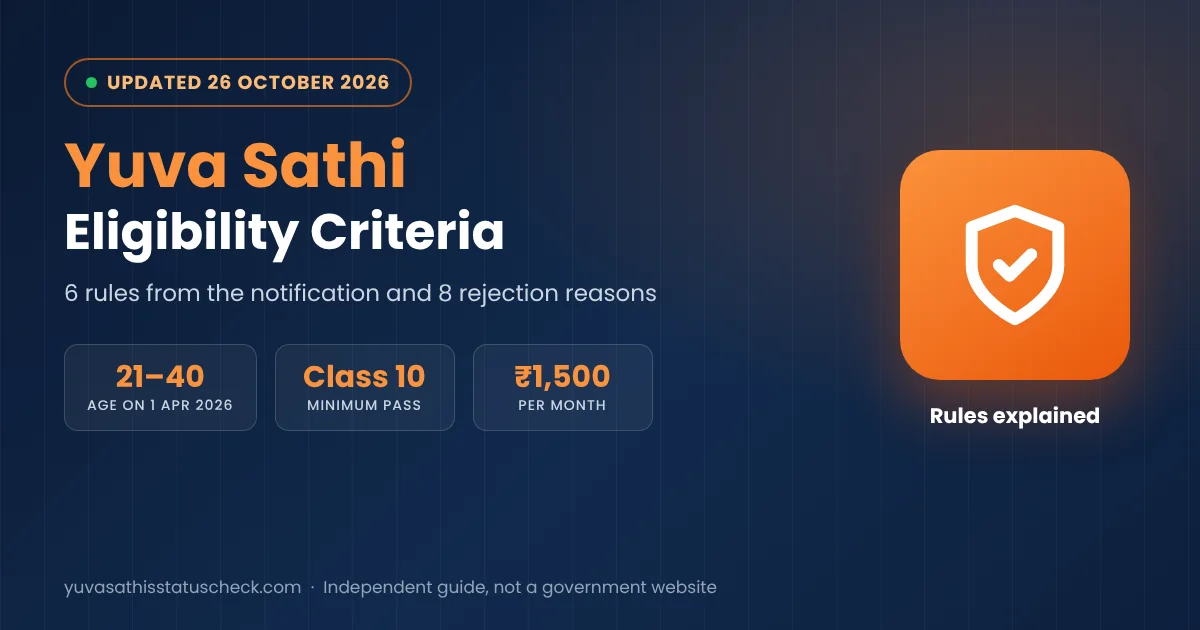
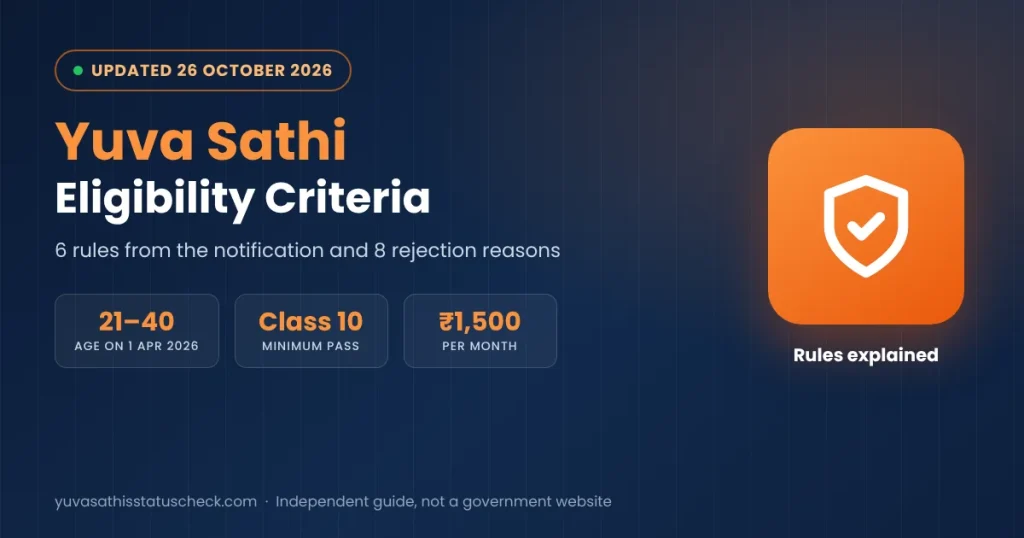
Quick answer: Under Notification No. 102/YS dated 13 February 2026, the Yuva Sathi eligibility criteria were: permanent resident of West Bengal, aged 21 to 40 years as on 1 April 2026, unemployed, and Madhyamik or equivalent pass. Applicants also needed a bank account in their own name linked with Aadhaar, and had to declare they did not get monthly assistance from a regular state government job.
Also read: Yuva Shakti vs Yuva Sathi: 10 key differences and unemployment certificate West Bengal.
Yuva Sathi eligibility criteria at a glance
The Banglar Yuva Sathi scheme offered ₹1,500 a month for up to five years. To get it, every applicant had to meet all the conditions below. Missing even one could lead to rejection.
| Rule | Yuva Sathi eligibility criteria | Source |
|---|---|---|
| 1. Residence | Permanent resident of West Bengal | Notification |
| 2. Age | 21 to 40 years as on 1 April 2026 | Notification |
| 3. Work status | Unemployed | Notification |
| 4. Education | Madhyamik or equivalent pass | Notification |
| 5. Bank account | Own single-name account, linked with Aadhaar | Notification |
| 6. Declaration | No monthly assistance from a regular state government job | Notification |
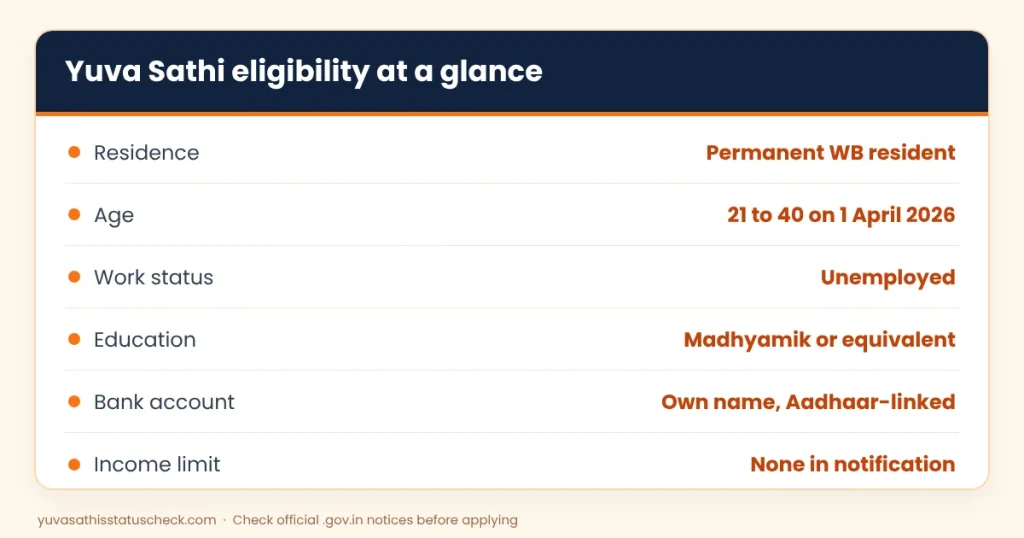
There was no family income limit in the notification. This is one of the biggest differences from the new Yuva Shakti scheme, which has an income limit of ₹1 lakh a year.
Rule 1: Permanent resident of West Bengal
Under the Yuva Sathi eligibility criteria, the scheme was only for permanent residents of the state. In practice, the voter card and Aadhaar card with a West Bengal address were the main proof, and the voter card was one of the required documents.
If you were born in Bengal but lived elsewhere for work, you could still be a permanent resident. But you also had to be unemployed at the time of applying, which often decided the case.
Rule 2: Age between 21 and 40 as on 1 April 2026
The notification fixed the age as “between 21 to 40 years as on 01.04.2026”. This means age was not counted on the day you applied, but on 1 April 2026.
| Born on | Age on 1 April 2026 | Within Yuva Sathi eligibility? |
|---|---|---|
| 1 April 2005 | 21 | Yes |
| 2 April 2005 or later | 20 | No, too young |
| 2 April 1985 | 40 | Yes |
| 1 April 1985 or earlier | 41 or more | No, too old |
So, roughly, people born between 2 April 1985 and 1 April 2005 were inside the age limit. The Madhyamik admit card was used as proof of date of birth. If your birthday is close to either end, the exact counting by officials decided the case.
Rule 3: You had to be unemployed
The scheme was for jobless youth only. The notification simply said the applicant “is unemployed”, and applicants signed a self-declaration.
Based on the notification and later guides, these were not treated as eligible:
- People with a regular job in government service.
- People with a regular private job.
- People who got a job after applying. Support was to stop once a beneficiary was employed.
Students receiving educational scholarships were not barred. The declaration made an exception for educational benefits and scholarships, so a scholarship alone did not disqualify you.
Rule 4: Madhyamik or equivalent pass
The Yuva Sathi eligibility criteria required you to have passed Madhyamik (Class 10) or an equivalent examination. Higher education was not required, and graduates and Madhyamik-pass applicants received the same ₹1,500.
Both the Madhyamik admit card and the mark sheet or pass certificate were collected. The admit card proved your date of birth, while the mark sheet proved you had passed.
Rule 5: A single-name bank account linked with Aadhaar
This rule caused more problems than most people expected. The notification asked for a bank account held solely by the applicant and linked with Aadhaar, so the money could be sent by Direct Benefit Transfer.
- Joint accounts did not meet this rule.
- Accounts in a parent’s name could not be used.
- Dormant accounts often failed when payments were sent.
- Aadhaar seeding had to be active for DBT.
Applicants also gave consent for Aadhaar-based authentication in the form.
Rule 6: No monthly assistance from a regular state job
Applicants had to declare that they did not receive monthly assistance from a regular state government job. Educational benefits and scholarships were allowed.
Several guides also listed beneficiaries of some other youth support schemes as not eligible. Because the exact exclusions were applied at the verification stage, ask your BDO or municipality office if you think another benefit affected your application.
Who did not meet the Yuva Sathi eligibility criteria
Putting the rules together, these groups did not meet the Yuva Sathi eligibility criteria:
- People aged below 21 or above 40 on 1 April 2026.
- Anyone who had not passed Madhyamik or an equivalent exam.
- People with a regular job, government or private.
- People who were not permanent residents of West Bengal.
- Applicants without a single-name, Aadhaar-linked bank account.
- People receiving monthly assistance that the declaration did not allow.
If you were in any of these groups, you were outside the Yuva Sathi eligibility criteria. Note that the new Yuva Shakti scheme has different rules. For example, its age limit goes up to 45.
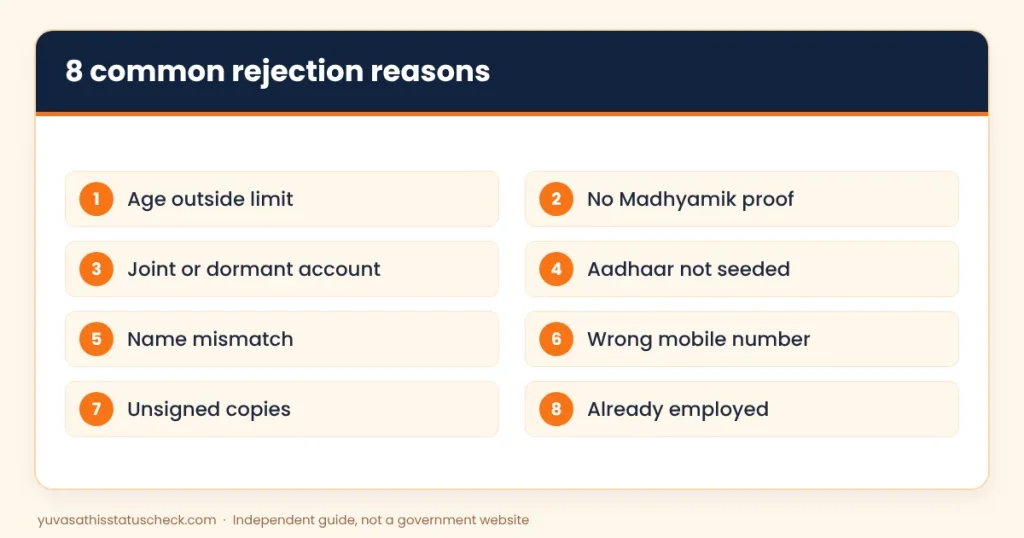
8 common reasons Yuva Sathi applications were rejected
Even people who met the Yuva Sathi eligibility criteria were sometimes rejected because of small errors. These are the reasons we hear about most often.
- Age outside the limit on 1 April 2026.
- No Madhyamik proof, or an unclear copy of the mark sheet.
- Joint or dormant bank account, so DBT could not be completed.
- Aadhaar not seeded with the bank account.
- Name mismatch between Aadhaar, voter card and Madhyamik papers.
- Wrong mobile number written on the form, so OTP and updates failed.
- Unsigned or not self-attested document copies.
- Already employed or receiving monthly assistance not allowed by the declaration.
Documents that proved each Yuva Sathi eligibility rule
Every rule in the Yuva Sathi eligibility criteria had a paper behind it. The notification listed self-attested copies of these documents.
| Rule | Document that proved it |
|---|---|
| Residence | Voter card, Aadhaar card |
| Age (21 to 40) | Madhyamik admit card |
| Education | Madhyamik mark sheet or pass certificate |
| Bank account | First page of passbook and a cancelled cheque |
| Identity | Aadhaar card and a recent passport-size photo |
| Caste (if applicable) | SC, ST or OBC certificate |
| Unemployment | Signed self-declaration in the form |
The official Yuva Sathi portal also listed a valid mobile number, because OTPs and updates were sent to it.
8 examples: who met the Yuva Sathi eligibility criteria?
Real cases make the rules easier to follow. These examples apply the published Yuva Sathi eligibility criteria; they are our reading, not official decisions.
| Person | Situation | Result under Yuva Sathi |
|---|---|---|
| Arpita, 23 | Madhyamik pass, no job, own Aadhaar-linked account | Eligible |
| Sujoy, 39 | HS pass, no job, joint account with father | At risk; needed a single-name account |
| Nasrin, 26 | BA graduate, no job | Eligible, same ₹1,500 as others |
| Partha, 42 | Madhyamik pass, no job | Not eligible (over 40) |
| Riya, 20 | HS pass, born in June 2005 | Not eligible (under 21 on 1 April 2026) |
| Debu, 31 | Regular salaried job in a private firm | Not eligible (employed) |
| Kakoli, 28 | College student with a merit scholarship, no job | Scholarship allowed; eligible if other rules met |
| Sanjib, 35 | Class 9 pass, no job | Not eligible (no Madhyamik) |
Notice that Partha, at 42, would now fit the Yuva Shakti age limit of 45. Rules change between schemes, so always check the new ones.
6 myths about Yuva Sathi scheme eligibility
Wrong information spread quickly while the camps were running. Here are the most common myths and the facts.
- “Only boys could apply.” False. The scheme was open to women and men.
- “You had to be a graduate.” False. Madhyamik pass was enough, and everyone got ₹1,500.
- “An income certificate was compulsory.” False for Yuva Sathi scheme eligibility. There was no income limit in the notification.
- “Employment bank registration was required.” Not listed in the notification’s eligibility conditions.
- “Scholarship students were blocked.” False. Educational benefits and scholarships were allowed.
- “You could apply at any time.” False. Forms were taken only from 15 to 26 February 2026.
If you skipped applying because of one of these myths, the new Yuva Shakti scheme is your next chance. Check its rules carefully, because some of them really are different.
How Yuva Sathi eligibility was verified
After the camps closed on 26 February 2026, applications were checked against the Yuva Sathi eligibility criteria through a verification process set out in the notification.
- Designated officers checked the forms and documents for each applicant.
- Eligible applicants were recommended for sanction.
- The District Magistrate sanctioned applications in the districts, and the Commissioner of Kolkata Municipal Corporation did so in KMC areas.
- Payment was sent by DBT to the Aadhaar-linked account.
- Beneficiary status was to be checked once a year, and support could stop if a person no longer met the rules.
This is why some people saw “pending” for a long time. With lakhs of forms, verification took weeks. You can see your stage through a Yuva Sathi status check on the official portal.
How to check if you were found eligible
The simplest way to know whether officials found you within the Yuva Sathi eligibility criteria is to check your application status.
- Open yubasathi.wb.gov.in and choose Application Status, then Check Status.
- Enter your registered mobile number and the captcha.
- Enter the OTP and tap Verify PIN.
- Read the status: approved or sanctioned means you were found eligible.
If the status shows rejected, the portal may not show the exact reason. Visit your BDO office in rural areas, or the municipality or borough office in towns, with your slip and Aadhaar card, and ask which rule was not met.
What if your situation changed after applying?
Eligibility was not a one-time check. The notification said beneficiary status would be verified every year, and support was meant to stop once the person found a job or joined another scheme.
- Got a job after applying: You were expected to stop receiving support. Continuing to take money while employed can lead to recovery later.
- Turned 41 after 1 April 2026: Age was counted on 1 April 2026, so a later birthday did not cancel your application by itself.
- Moved to another state for work: Being employed would matter more than the move.
- Changed your bank account: Payments could fail until the new account was updated in your record.
Different spellings, same eligibility rules
Because the scheme name comes from Bengali, you will see it written in many ways: Yuva Sathi, Yuba Sathi, Jubo Sathi, Yubasathi and Banglar Yuva Sathi. Searches like “Jubo Sathi prokolpo eligibility” or “Yuba Sathi eligibility criteria” all refer to the same scheme and the same six rules explained on this page.
How long could you stay eligible?
Yuva Sathi support was meant to last up to five years, or until the beneficiary found a job or enrolled in another scheme, whichever came first. The notification also allowed the government to stop or withhold support if it had been sanctioned by mistake or if the conditions no longer applied, after giving the person a chance to be heard.
After the change of government in May 2026, payments were reported to be paused for verification. Read more in our Yuva Sathi payment date article.
Yuva Sathi eligibility vs Yuva Shakti eligibility
The new Yuva Shakti scheme, announced in the June 2026 budget, changes several rules. If you were rejected under Yuva Sathi, you may still qualify for Yuva Shakti, or the other way round.
| Point | Yuva Sathi | Yuva Shakti (announced) |
|---|---|---|
| Age | 21 to 40 on 1 April 2026 | 21 to 45 |
| Education | Madhyamik pass | Madhyamik pass; graduates paid more |
| Income limit | None in notification | Below ₹1 lakh a year |
| Amount | ₹1,500 a month | ₹3,000 or ₹2,000 a month |
| Duration | Up to 5 years | While unemployed, as reported |
Read the full rules in our Yuva Shakti eligibility guide.
Rejected under Yuva Sathi? What you can do now
Failing the old Yuva Sathi eligibility criteria does not stop you from applying for the new scheme. Use the time to fix whatever caused the problem.
- Find out the reason. Ask your BDO, SDO or municipality office what condition was not met.
- Fix bank issues. Open or activate a single-name account and get Aadhaar seeded.
- Correct your papers. Make names and dates of birth match across Aadhaar, voter card and Madhyamik papers.
- Check the new rules. If you were over 40, the Yuva Shakti limit of 45 may now include you.
- Get an income certificate. Yuva Shakti has an income limit that Yuva Sathi did not have.
Most people who were rejected for document errors can avoid the same problem next time with a few days of preparation.
Frequently asked questions
What were the Yuva Sathi eligibility criteria?
Permanent resident of West Bengal, aged 21 to 40 as on 1 April 2026, unemployed, Madhyamik or equivalent pass, with a single-name Aadhaar-linked bank account.
Was there an income limit in Yuva Sathi eligibility?
No. The notification did not set a family income limit. The new Yuva Shakti scheme does have one, of ₹1 lakh a year.
What age was counted for Yuva Sathi scheme eligibility?
Age was counted as on 1 April 2026. Roughly, people born between 2 April 1985 and 1 April 2005 were inside the limit.
Could students apply for Yuva Sathi?
Educational benefits and scholarships did not disqualify an applicant, but the person still had to be unemployed and meet every other rule.
Could graduates get more money under Yuva Sathi?
No. Everyone approved under Yuva Sathi got the same ₹1,500 a month. Higher pay for graduates is a feature of the new Yuva Shakti scheme.
Could women apply for Yuva Sathi?
Yes. The scheme was open to both women and men who met the Yuva Sathi eligibility criteria.
Can I still apply for Yuva Sathi if I am eligible?
No. Applications closed on 26 February 2026. See our Yuva Sathi last date guide for details.
Did I need a caste certificate to be eligible?
No. A caste certificate was collected only from SC, ST and OBC applicants where applicable. It was not a condition of Yuva Sathi eligibility for everyone.
Can a person rejected under Yuva Sathi apply for Yuva Shakti?
Yes. Yuva Shakti is a separate scheme with its own rules. If you meet its conditions, a Yuva Sathi rejection does not stop you from applying when the form opens.
Who approved Yuva Sathi applications?
The District Magistrate sanctioned applications in the districts, and the KMC Commissioner did so for Kolkata Municipal Corporation areas.
Sources we checked
- Banglar Yuba Sathi notification, No. 102/YS, 13 February 2026: eligibility wording, bank account rule, sanctioning authority and duration.
- ClearTax guide on Banglar Yuva Sathi: who was not eligible and scholarship exceptions.
- Careers360 (PTI), 15 February 2026: age 21 to 40 and ₹1,500 for up to five years.
This is an independent guide, not a government website. Rules are taken from the published notification and reports; check official sources for any later change.