Yuva Shakti Eligibility 2026: 7 Rules to Get ₹3,000 or ₹2,000 (Check in 1 Minute)
Last updated: 25 October 2026. Before you rush to fill the form, it pays to check your Yuva Shakti eligibility. If you do not meet even one condition, your application can be rejected after weeks of waiting, and you may lose the chance to fix it in time.
This guide breaks the Yuva Shakti eligibility criteria into 7 simple rules. For each rule we explain what was announced, what is still unclear and which document proves it. You will also find 10 real-life examples and a 1-minute self-check at the end.
Quick answer: As announced in the June 2026 budget and reported since, Yuva Shakti eligibility needs you to be a permanent resident of West Bengal, aged 21 to 45, at least Madhyamik pass, unemployed, from a family earning below ₹1 lakh a year, and not getting another social security benefit. Graduates get ₹3,000 a month; other eligible youth get ₹2,000.
Also read: Yuva Shakti scheme West Bengal 2026: complete guide and Bhorsha Karmasuchi explained.
Yuva Shakti eligibility at a glance
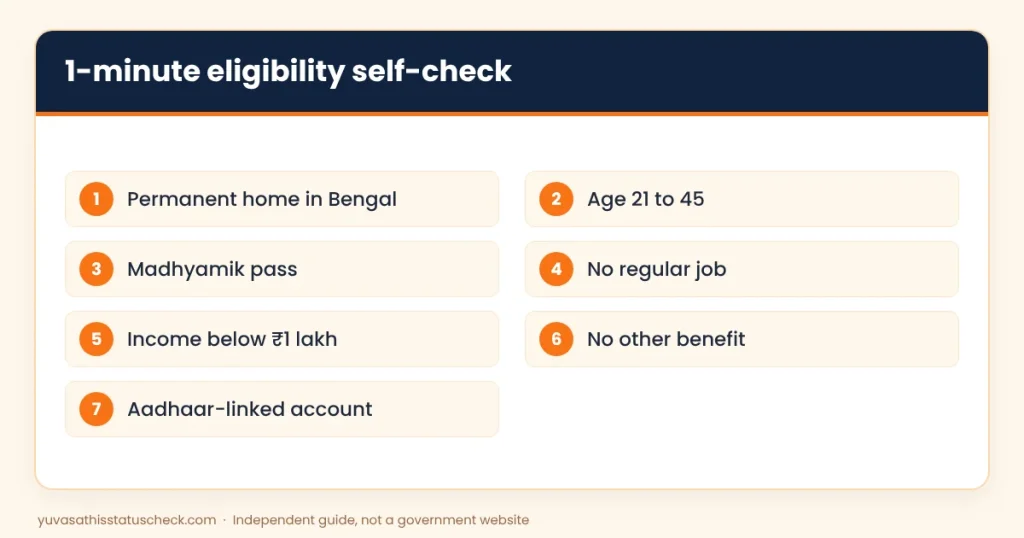
Here is the full list of Yuva Shakti eligibility criteria as they stand today. Remember that these come from the budget and news reports. The final notification may add or change a rule.
| Rule | Yuva Shakti eligibility condition | Status |
|---|---|---|
| 1. Residence | Permanent resident of West Bengal | Announced |
| 2. Age | 21 to 45 years | Announced |
| 3. Education | At least Madhyamik pass | Reported |
| 4. Work status | Unemployed when applying | Announced |
| 5. Family income | Below ₹1 lakh a year | Announced |
| 6. Other benefits | Not getting another social security benefit | Announced |
| 7. Bank account | Own account, linked with Aadhaar | Reported |
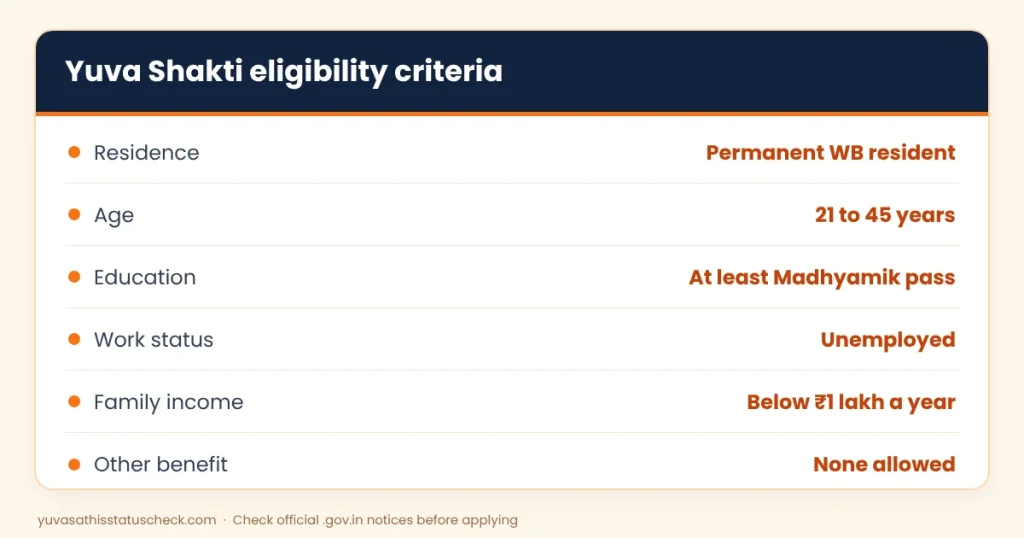
If you can tick all seven, you are very likely inside the Yuva Shakti eligibility rules. If you are unsure about one, read that rule’s section below.
Rule 1: You must be a permanent resident of West Bengal
The scheme is for young people of West Bengal only. You should have a permanent address in the state, not just a temporary job or college address here.
What may prove it: Aadhaar card with a West Bengal address, voter card from a West Bengal constituency, or a residential certificate from the e-District service.
Grey areas: If you were born in Bengal but now work in another state, you may still be a permanent resident, but you would also need to show that you are unemployed. If you moved to Bengal recently, wait for the final rules on proof of residence.
Rule 2: Age between 21 and 45 years
The budget raised the age limit to 21 to 45 years. The old Yuva Sathi scheme allowed only 21 to 40, so many people who were too old for Yuva Sathi now meet the Yuva Shakti eligibility age rule.
The final notice will say on which date your age is counted. Yuva Sathi counted age as on 1 April 2026. If your birthday is close to 21 or 45, wait for that date before you decide. Our Yuva Shakti age limit guide has worked examples.
What may prove it: Madhyamik admit card, birth certificate or Aadhaar card.
Rule 3: Minimum education is Madhyamik pass
Reports say you need to have passed at least Madhyamik (Class 10) or an equivalent exam. This rule also decides how much you get.
| Your highest education | Likely monthly amount |
|---|---|
| Graduate (BA, BSc, BCom or equal) | ₹3,000 |
| Higher Secondary (Class 12) pass | ₹2,000 |
| Madhyamik (Class 10) pass | ₹2,000 |
| Below Madhyamik | Likely not eligible |
Graduates: Keep your final degree certificate or final mark sheet ready. If your result is pending, you may be placed in the ₹2,000 group until you can show proof.
Diploma and ITI holders: It is not yet clear whether diplomas count as graduation. Wait for the final Yuva Shakti eligibility criteria before you assume the ₹3,000 level.
Rule 4: You must be unemployed
The scheme is meant for jobless youth. You should not have a regular job in government or the private sector when you apply.
What “unemployed” covers is not fully defined yet. Based on the old Yuva Sathi rules and news reports, this is how it is likely to work:
- Regular government job: Not eligible.
- Regular private job with salary: Not eligible.
- Contract or part-time worker with steady pay: Probably not eligible. Wait for the final notice.
- Occasional daily work with no fixed income: Unclear; this is the biggest grey area.
- Full-time student: Not confirmed. Under Yuva Sathi, scholarships did not disqualify you, but the new rules may differ.
You may also have to sign a self-declaration that you are unemployed. Giving a false declaration can lead to the money being stopped or recovered later, so be honest.
Rule 5: Family income below ₹1 lakh a year
This is the biggest change from Yuva Sathi, which had no income limit. As announced, your family’s total income must be below ₹1 lakh a year to meet the Yuva Shakti eligibility rule.
A few points to understand:
- Family income, not just yours. The income of parents and other earning members is usually added.
- Yearly, not monthly. One news report mentioned a monthly figure, but the budget announcement used an annual limit of ₹1 lakh.
- Proof matters. A recent income certificate from the BDO or SDO office is the safest proof. See our income certificate West Bengal guide.
Getting an income certificate can take a few weeks, so apply now instead of waiting for the form to open.
Rule 6: No other social security benefit
The budget said the support is for youth who are not already getting a benefit under another social protection scheme. The exact list of schemes that block you has not been published.
Under Yuva Sathi, people getting other monthly state assistance were excluded, while education scholarships were allowed. A similar approach is likely, but treat this as unconfirmed.
If you or your family members get any monthly payment from the state, keep its details handy. The final form may ask you to declare it.
Rule 7: A bank account in your own name, linked with Aadhaar
The money is expected to come by Direct Benefit Transfer. For that, you need a savings account in your own name, with KYC done and Aadhaar seeded for DBT.
- Joint accounts caused many problems under Yuva Sathi. Use a single-name account.
- Dormant accounts must be made active before you apply.
- Aadhaar seeding can be checked on the myAadhaar portal under bank seeding status.
Yuva Shakti bharosa card eligibility: 10 real examples
Rules are easier to understand with real cases. Here are 10 common situations and how Yuva Shakti bharosa card eligibility is likely to apply. These are our reading of the announced rules, not official decisions.
| Person | Situation | Likely result |
|---|---|---|
| Rina, 24 | BA graduate, no job, family income ₹80,000 | Eligible, ₹3,000 |
| Sourav, 30 | HS pass, no job, family income ₹70,000 | Eligible, ₹2,000 |
| Amit, 43 | Madhyamik pass, no job, low income | Eligible, ₹2,000 (too old for Yuva Sathi) |
| Puja, 22 | Final-year BSc, result pending | Likely ₹2,000 until degree proof |
| Rahul, 27 | Graduate, works in a shop for a monthly salary | Likely not eligible (employed) |
| Sneha, 20 | Graduate, no job | Not yet eligible (below 21) |
| Imran, 46 | Graduate, no job | Not eligible (above 45) |
| Tania, 29 | Graduate, family income ₹1.5 lakh | Likely not eligible (income) |
| Bikash, 33 | Class 8 pass, no job | Likely not eligible (education) |
| Moumita, 35 | Graduate, already gets another monthly state benefit | Likely not eligible (other benefit) |
Who is not eligible for Yuva Shakti
From the announced rules, these groups are likely to fall outside Yuva Shakti eligibility:
- People below 21 or above 45 years of age.
- People who are not permanent residents of West Bengal.
- Anyone who has not passed Madhyamik or an equivalent exam.
- People with a regular job or steady salary.
- Families with an income of ₹1 lakh or more a year.
- People already receiving another social security benefit.
If you are close to any of these lines, keep your documents ready and read the final notice carefully. Small details, such as the date used for age or the definition of income, can change the result.
Special cases: caste, gender and disability
Many readers ask whether some groups get easier Yuva Shakti eligibility rules. Here is what is known so far.
SC, ST and OBC applicants
No age relaxation or separate amount for SC, ST or OBC applicants has been announced. Under Yuva Sathi, a caste certificate was collected where applicable, mainly for records. Keep your caste certificate ready, because the new form may ask for it, but do not expect a different age limit unless the final notice says so.
Women applicants
The scheme is open to young women and men alike. A woman who already receives another monthly state benefit should check the final rules carefully, because the “no other social security benefit” condition may apply to her.
Applicants with a disability
No special rule for persons with disabilities has been announced yet. If you already get a disability pension, the “other benefit” rule may matter. Keep your disability certificate ready and wait for the final notice.
7 common Yuva Shakti eligibility mistakes
These mistakes cause many rejections in new schemes. Avoid them and your form has a much better chance.
- Counting only your own income. The limit is for family income, so include all earning members.
- Using an old income certificate. Get a recent one that shows the current year’s income.
- Mismatched date of birth. If Aadhaar and your Madhyamik admit card show different dates, fix this first.
- Applying as a graduate without proof. Without a degree certificate or final mark sheet, you may be placed at ₹2,000.
- Hiding a job. Even a small regular salary can make you ineligible, and a false declaration can lead to recovery later.
- Using a joint bank account. Open or use a single-name account linked with Aadhaar.
- Trusting unofficial checkers. Websites that “check your eligibility” with your Aadhaar number are not government tools.
You are eligible: what to do now
If you passed the self-check, use the waiting time well. These steps take only a few days but can save you weeks later.
- Apply for a family income certificate if yours is older than a year.
- Make sure your name is on the voter list on the ECI electoral search site, since one report listed it as a condition.
- Collect your Madhyamik admit card, mark sheet and highest certificate in one folder.
- Check that your bank account is active and Aadhaar-seeded.
- Keep a passport-size photo and a signature scan on your phone.
- Follow our Yuva Sathi news page for the official form date.
When the notification comes out, compare it with this page line by line. If the final Yuva Shakti eligibility criteria change, we will update this guide on the same day.
Yuva Shakti vs Yuva Sathi eligibility
Many people who applied for Yuva Sathi want to know if they automatically meet the new rules. They may not. Compare the two side by side.
| Point | Banglar Yuva Sathi | Yuva Shakti |
|---|---|---|
| Age | 21 to 40 | 21 to 45 |
| Education | Madhyamik pass | Madhyamik pass; graduates paid more |
| Income limit | None in notification | Below ₹1 lakh a year |
| Amount | ₹1,500 a month | ₹3,000 or ₹2,000 a month |
| Other benefit | Monthly state aid not allowed | Social security benefit not allowed |
The income limit is the key difference. A Yuva Sathi beneficiary from a family earning more than ₹1 lakh may not pass the Yuva Shakti eligibility test, even though nothing else has changed.
1-minute Yuva Shakti eligibility self-check
Answer these seven questions with yes or no. If all answers are “yes”, you are likely eligible.
- Is your permanent home in West Bengal?
- Will you be between 21 and 45 years old on the counting date?
- Have you passed Madhyamik or an equivalent exam?
- Are you without a regular job or salary right now?
- Is your family’s yearly income below ₹1 lakh?
- Are you free of any other social security benefit?
- Do you have an active bank account in your own name, linked with Aadhaar?
If you answered “yes” to all seven, start collecting your documents now. Our Yuva Shakti Bharosa card guide and Yuva Shakti online apply page explain the next steps.
How to prove your Yuva Shakti eligibility
Every rule needs a paper behind it. Keep this simple mapping in mind.
| Rule | Document that may be asked |
|---|---|
| Residence | Aadhaar, voter card or residential certificate |
| Age | Madhyamik admit card or birth certificate |
| Education | Madhyamik mark sheet, HS or degree certificate |
| Income | Family income certificate |
| Unemployment | Self-declaration form |
| Bank | Passbook first page or cancelled cheque |
Keep self-attested copies and clear scans of each one. Names and dates of birth should match across all papers.
What if your situation changes after you apply?
Yuva Shakti eligibility is not checked only once. Under Yuva Sathi, beneficiary status was to be verified every year, and the new scheme is reported to stop the money from the month after you get a job. Expect similar checks.
- You get a job: Inform the office. Payments are meant to stop once you are employed.
- You finish graduation: Keep your new certificate ready. You may be able to move from ₹2,000 to ₹3,000 if the rules allow it.
- Family income rises: If it crosses ₹1 lakh, you may no longer qualify at the next check.
- You cross 45: The final rules will say whether support continues after the upper age limit.
Being honest about changes protects you from having to return money later.
Frequently asked questions
What is the Yuva Shakti eligibility age?
As announced in the 2026-27 budget, the Yuva Shakti eligibility age is 21 to 45 years. The final notice will say on which date your age is counted.
Who gets ₹3,000 under Yuva Shakti?
Unemployed graduates who meet all other Yuva Shakti eligibility criteria get ₹3,000 a month, as announced. Others who have passed at least Madhyamik get ₹2,000.
Is there an income limit for Yuva Shakti?
Yes. The family income should be below ₹1 lakh a year, as announced in the budget. Yuva Sathi did not have this limit.
Can girls apply for Yuva Shakti?
Yes. The announced rules do not limit the scheme by gender. Eligible young women and men can both apply.
Can students apply for Yuva Shakti?
This is not confirmed yet. The final Yuva Shakti eligibility criteria should clarify whether full-time students count as unemployed.
I got Yuva Sathi. Am I eligible for Yuva Shakti?
Not automatically. You must meet the new rules, especially the ₹1 lakh family income limit. Reports also say old applicants may need to apply again.
Is employment bank registration needed?
It has not been officially confirmed. Some sites expect it, so registering on the state employment bank portal may help, but it is not a stated rule yet.
Where will the official Yuva Shakti eligibility list be published?
It will be part of the government notification for the scheme. We will update this page with the final rules when it is published.
Sources we checked
- Asianet News Bangla, 12 October 2026: age 21 to 45, education, income and Aadhaar-linked bank account.
- Indiahood, 17 October 2026: Madhyamik pass, unemployed, voter list and amounts.
- GovtSchemes.in: budget of 22 June 2026, ₹1 lakh income limit, other benefits rule.
- Drishti IAS, 13 June 2026: early announcement of the Yuva Shakti Bharosa Card.
- Banglar Yuba Sathi notification, 13 February 2026: old scheme rules used for comparison.
This is an independent guide, not a government website. Final Yuva Shakti eligibility rules will come from the official notification.
3 Comments