Taruner Swapna 2026: Is the ₹10,000 Tab Scheme Stopped? Latest Update, Status & What Students Should Do
Last checked: 3 November 2026. For years, Class 11 students in West Bengal’s government schools waited for the Taruner Swapna money: a one-time ₹10,000 to buy a tablet or smartphone. In 2026, the big question is different. After the change of government, many students and parents want to know whether Taruner Swapna will continue at all.
This guide brings together the latest reports in one place, in simple words. It explains what Taruner Swapna is, what the Chief Minister has said in 2026, whether the scheme has really been stopped, how the payment used to work, how to check old status and what students can do now.
Quick answer: On 12 September 2026, a news report said Chief Minister Suvendu Adhikari announced that Taruner Swapna will not continue and that the money will be used for school infrastructure instead. As of 3 November 2026, we have not seen a published government order on this. No new ₹10,000 payments have been announced for the 2026 batch.
Also read: SVMCM scholarship 2026-27 and Bhagini Nivedita Scheme.
What is Taruner Swapna?
Taruner Swapna (তরুণের স্বপ্ন, “the dream of the young”) is a West Bengal scheme that gave a one-time grant of ₹10,000 to students so they could buy a tablet, smartphone or other device for study. It was started by the previous state government after the Covid period, when online classes made devices essential.
The scheme first covered Class 12 students and was later given to Class 11 students. The money was sent directly to the student’s bank account by Direct Benefit Transfer (DBT).
Taruner Swapna at a glance
| Point | Details |
|---|---|
| Benefit | One-time ₹10,000 to buy a tablet, smartphone or PC |
| Who got it | Class 11 students (earlier Class 12) |
| Schools | Government, government-aided and sponsored schools and madrasahs |
| Income rule | Family income below ₹2 lakh a year |
| How to apply | Through the school, with student details on the Banglar Shiksha system |
| Payment mode | DBT to the student’s bank account |
| Status in 2026 | Reported as discontinued by the CM; no published order seen |
Taruner Swapna 2026: what has happened so far?
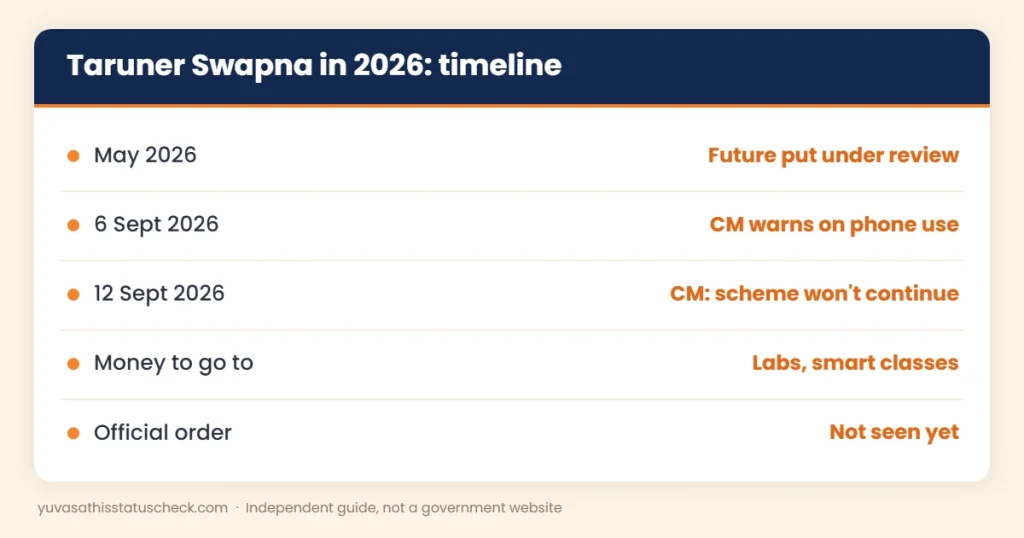
The future of the scheme became uncertain soon after the new government took office in May 2026. Here is the timeline of the main reports.
| Date | What was reported |
|---|---|
| 25 May 2026 | A meeting at Bikash Bhavan raised doubts about the scheme; the government said no welfare scheme would simply be shut, but filtering could come |
| 6 September 2026 | At a Vidyasagar Shiksha Samman event, the CM spoke strongly about students’ late-night phone use; a report said no decision had been taken yet |
| 12 September 2026 | A report said the CM announced at a Teachers’ Day event that the scheme will not continue |
| 3 November 2026 | No published government order or new payment date seen by us |
What the Chief Minister said
According to the 12 September report, the Chief Minister said the state would not hold back on technology and modern infrastructure in schools, but would not fund phones for students. The report quoted him in Bengali as saying, “But I will not give mobile phones.”
He also spoke about the harm of heavy phone use on studies and sleep, and mentioned Gujarat’s rule that keeps phones out of schools. The report said the money will instead go to computer labs, smart classrooms and better learning material in schools.
Is Taruner Swapna stopped? The honest answer
Based on the reports, the scheme is not expected to continue in its old form. But there are three important points to keep in mind:
- The announcement came in a speech. We have not seen a notification or government order published on an official website.
- Old pending cases are unclear. There is no public word on students from earlier batches whose payment failed or is still pending.
- Plans can change. Teachers’ groups and parents are divided on the issue, and the final rules may differ from the speech.
Until an order is published, the reports are the best guide we have, and they all point in the same direction. So the safest way to read the situation is this: do not expect a new Taruner Swapna payment for the 2026-27 batch unless your school or the School Education Department announces it officially.
Why the new government wants to change Taruner Swapna
The reports give several reasons that have been discussed in 2026:
- Phone addiction: concern that students spend too much time on phones, social media and games.
- Attendance: some teachers said a few students enrolled only to get the money and then stopped attending. A May report mentioned a 15 to 20 percent gap between registered students and actual exam candidates in 2024.
- Fraud: in 2024, reports said some payments went to fake or hacked bank accounts.
- Better use of money: some teachers’ bodies argued that the same funds could improve labs, libraries and classrooms for everyone.
On the other side, supporters say the scheme helped many poor students get a device, and that a complete stop will hurt them. Some suggested keeping it only for low-income families, or giving devices through schools instead of cash.
How Taruner Swapna worked (for reference)
If you are trying to understand an old payment, this is how the process usually worked:
- The school collected student details, including bank account, Aadhaar and family income.
- The school entered or verified the details on the state’s Banglar Shiksha system, where each student has a Student Code.
- Students or guardians gave a self-declaration through the system the school used.
- After checks, the ₹10,000 was sent by DBT to the student’s bank account.
- The student was expected to use it to buy a tablet or smartphone for study.
Who was eligible
- Students of Class 11 (earlier Class 12) in government, government-aided or sponsored schools and madrasahs of West Bengal.
- Family income below ₹2 lakh a year.
- A bank account in the student’s own name, linked with Aadhaar for DBT.
How to check Taruner Swapna status (old payments)
For old payments, the school is the main point of contact. Follow these steps:
- Ask your school. The teacher in charge of the scheme can see whether your details were uploaded and whether payment was processed.
- Check your bank passbook or SMS. DBT payments usually show the department name or scheme name in the narration.
- Check your Student Code. Your school or the Banglar Shiksha portal can help you find your Student Code, which is used to track records.
- Check Aadhaar seeding. If your bank account is not seeded for DBT, the payment can fail. Our DBT link guide shows how to check this on myAadhaar.
If your school says the payment failed because of wrong bank details, ask whether a correction is still possible for your batch.
Taruner Swapna for the 2026-27 batch: what to expect
If you are in Class 11 in 2026-27, here is what to expect based on the latest reports:
- No new Taruner Swapna application or payment date has been announced for your batch.
- The CM’s statement points to school-level infrastructure instead of individual cash.
- Your school may get smart classrooms or computer labs instead.
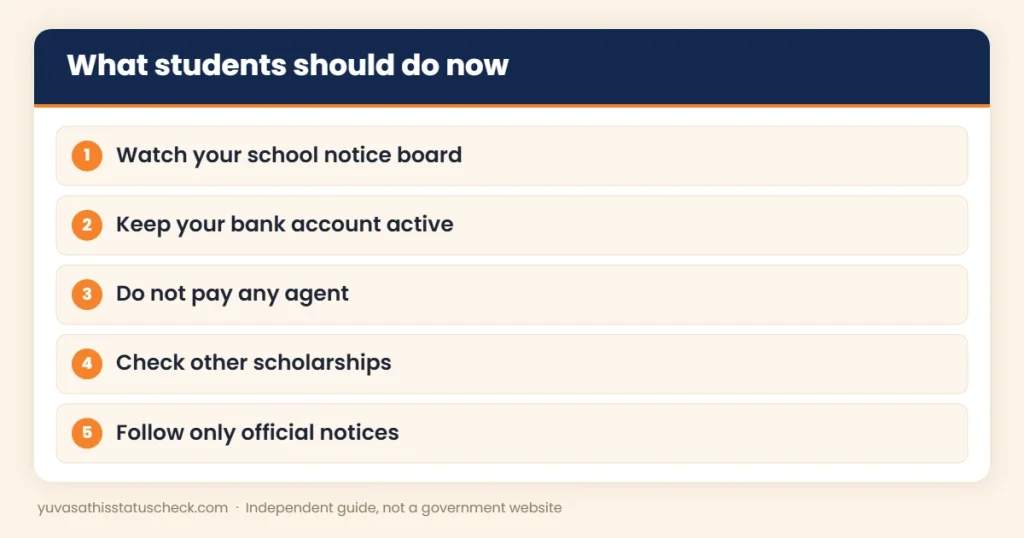
- If the government issues any new notice, it will come through your school and the School Education Department.
Many fake messages are shared every year around this time. Do not believe social media posts that say “Taruner Swapna money released today” unless your school confirms it.
What to do if an old payment failed
Some students from earlier batches say their money never arrived. The usual reasons are a wrong account number or IFSC, an account not seeded with Aadhaar, an inactive account or a name mismatch between school records and the bank. If this happened to you:
- Collect a fresh copy of your bank passbook’s first page.
- Check your Aadhaar seeding status on the myAadhaar portal.
- Meet the teacher in charge at your school with these papers.
- Ask in writing whether your batch’s corrections are still being accepted.
Keep a copy of everything you submit. If the school says corrections are closed, ask them to note your case in case the department reopens old cases later.
Why devices still matter for students
A tablet or phone is not only for games. Many things that students now do need a device: filling scholarship forms, downloading admit cards, checking results, joining online classes and using study apps. That is why the debate is not simple. Families with no device at home can fall behind, while heavy unsupervised use can also hurt studies.
The government’s stated plan is to give access through schools, with computer labs and smart classrooms, rather than giving each student money. If that plan goes ahead, students will need to make good use of school time on computers.
Free and low-cost ways to study online
If you do not have your own device, these options can help:
- School computer labs: ask your school when the lab is open for students.
- Public and school libraries: many have computers and free reading material.
- National learning platforms: DIKSHA and SWAYAM offer free courses and study material that can be used on a shared family phone.
- Shared devices: a family phone used with a fixed study time can work well.
- Printed notes: ask teachers for printed material when online content is not possible.
Tips for parents
- Talk to your child’s school about how the change affects your family.
- Keep your child’s bank account active, as other schemes also pay by DBT.
- If your child uses a phone, set clear study and sleep times.
- Encourage use of school labs and libraries.
- Keep income and caste certificates ready for scholarships.
What students can do instead
Even if the tablet grant ends, other support for students and young people is being planned or already running. These are worth watching:
| Support | Who it is for | Status (as reported) |
|---|---|---|
| Kanyashree / Kanyaratna | Girls in school and college | Running; K1 to rise to ₹2,000 a year from 2027 |
| ₹50,000 grant for college girls | Unmarried girls entering UG courses | Announced in Budget 2026-27 |
| Grant for competitive exam students | Students preparing for jobs and exams | Announced in Budget 2026-27; details awaited |
| Free coaching centres | Rural and poor students preparing for exams | Announced in Budget 2026-27 |
| Yuva Shakti (₹3,000 / ₹2,000) | Unemployed youth aged 21 and above | Form not open yet |
For the girls’ scheme, read our Kanyashree Prakalpa update. For young people who have finished their studies, see our Yuva Shakti scheme guide and the Bhorsha Karmasuchi explainer.
How schools may change
If the money is moved to school infrastructure, as the report says, students may see changes such as:
- New or upgraded computer labs with internet access.
- Smart classrooms with projectors or large screens.
- Better learning material and library resources.
- Stricter rules on using phones during school hours.
These changes would benefit all students in a school, not only those in one class. But they will take time to set up, and the timeline has not been announced. Ask your school whether it has received any instructions from the department.
What about devices already bought?
Students who received the money in earlier years and bought a tablet or phone do not need to return anything. The grant was a one-time payment for that batch. Keep the device for study, and use it to fill scholarship and admission forms in the coming years.
Key points to remember
- The tablet grant was a one-time ₹10,000 for Class 11 (earlier Class 12) students.
- In September 2026, the CM was reported as saying it will not continue.
- No published order or new payment date has been seen as of 3 November 2026.
- Money is expected to go to school labs and smart classrooms instead.
- Other student support, such as Kanyashree and the new college grant for girls, is planned or running.
- Never pay anyone to get scheme money.
Documents to keep ready for any new student scheme
Whatever replaces it, student schemes in West Bengal usually ask for the same papers. Keep these ready:
- Aadhaar card of the student.
- A bank account in the student’s own name, seeded with Aadhaar.
- School ID or admission receipt.
- Madhyamik admit card and marksheet.
- Family income certificate; see our income certificate West Bengal guide.
- Caste certificate, if applicable; see our caste certificate West Bengal guide.
- Residential proof; see our residential certificate West Bengal guide.
Beware of Taruner Swapna scams
Every time a scheme changes, scammers become active. Protect yourself and your family:
- No one can “restart” the tablet grant for you for a fee.
- Do not share OTPs, bank PINs or Aadhaar OTPs with callers claiming to release your ₹10,000.
- Do not fill forms on websites that ask for money to apply.
- Trust only your school, the School Education Department and official .gov.in websites.
- Report fraud on 1930 or at cybercrime.gov.in.
Taruner Swapna: arguments for and against
| For continuing Taruner Swapna | For stopping Taruner Swapna |
|---|---|
| Helps poor students get a device | Concern about phone addiction |
| Useful for online forms and study apps | Some students left school after getting money |
| Direct benefit to the student | Fraud in some payments in 2024 |
| Five years of use by many families | Money could improve labs for all students |
Whatever the final decision, the debate shows that the government is looking at value for money and student discipline more closely in 2026.
Frequently asked questions
Is Taruner Swapna stopped in 2026?
A 12 September 2026 report said the Chief Minister announced that Taruner Swapna will not continue. As of 3 November 2026, we have not seen a published government order.
Will Class 11 students get ₹10,000 in 2026-27?
No new payment date has been announced. Based on the CM’s statement, a new ₹10,000 payment for the 2026-27 batch looks unlikely unless an official notice says otherwise.
What will replace Taruner Swapna?
The report said the money will be used for school infrastructure, such as computer labs and smart classrooms, instead of cash for phones.
How much money did Taruner Swapna give?
A one-time ₹10,000 to buy a tablet, smartphone or other device for study.
Who was eligible for Taruner Swapna?
Class 11 students (earlier Class 12) of government, aided and sponsored schools and madrasahs, with family income below ₹2 lakh a year.
How can I check my old Taruner Swapna payment?
Ask your school’s Taruner Swapna in-charge, check your bank passbook or SMS, and make sure your bank account is seeded with Aadhaar.
Should I pay someone to get Taruner Swapna money?
Never. There is no fee, and anyone asking for money is a scammer.
Are there other schemes for students?
Yes. Kanyashree (now Kanyaratna) continues for girls, and the 2026-27 budget announced a ₹50,000 grant for college girls, free coaching centres and help for competitive exam students.
Sources we checked
- India Hood Bangla, 12 September 2026: CM says Taruner Swapna will not continue; money to school infrastructure.
- EduTips, 6 September 2026: CM’s remarks on phone use; no decision at that point.
- ExamBangla, 25 May 2026: review of the scheme, arguments for and against.
- WBXPRESS: Taruner Swapna: ₹10,000 grant, eligibility and income limit.
Disclaimer: yuvasathisstatuscheck.com is an independent information website. It is not connected with the Government of West Bengal. Always follow your school’s instructions and official notices.
5 Comments