BJP 3000 Scheme West Bengal 2026: Which Schemes Pay ₹3,000? Annapurna, Yuva Shakti & Farmers Explained
Last checked: 3 November 2026. Since the 2026 Assembly election, many people in West Bengal search for the “BJP 3000 scheme”. Some think it is one scheme that gives ₹3,000 to everyone. In reality, the BJP 3000 scheme is a popular name for a few different promises that each involve ₹3,000.
If you are confused, you are not alone. This guide explains what people mean by the BJP 3000 scheme, which schemes actually pay ₹3,000, who can get each one, where they stand today and how to avoid fake forms.
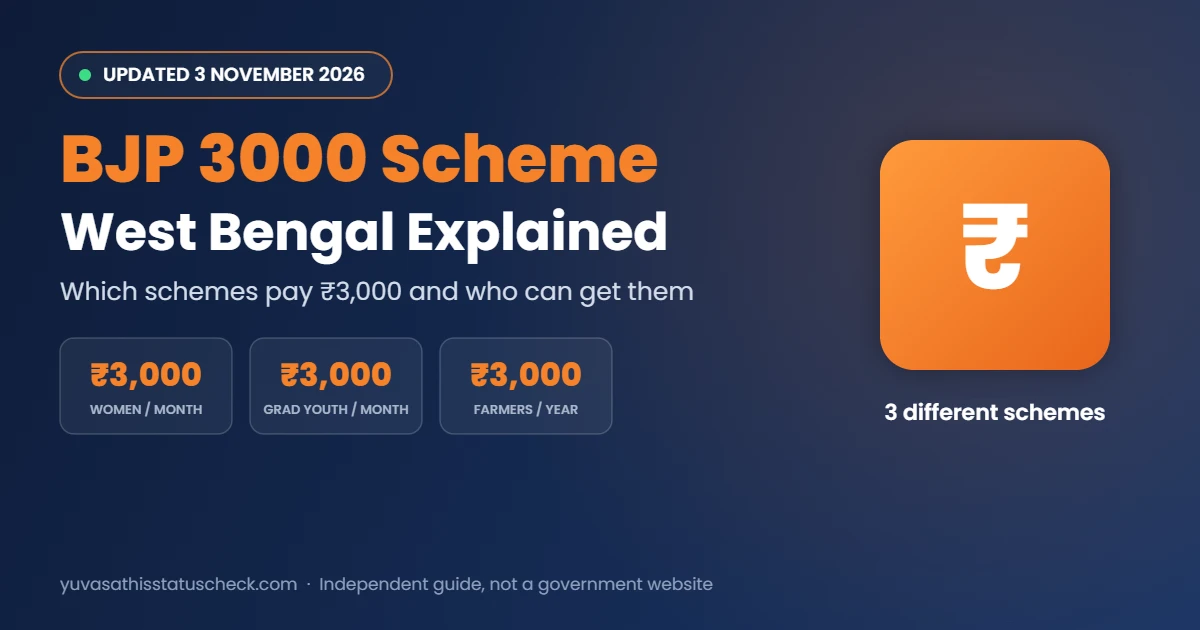
Quick answer: The BJP 3000 scheme usually refers to two monthly promises: ₹3,000 for eligible women under Annapurna Bhandar, and ₹3,000 for unemployed graduates under Yuva Shakti (₹2,000 for other eligible youth). The 2026-27 budget also gave farmer families ₹3,000 a year on top of PM-KISAN. Annapurna has rolled out; the Yuva Shakti form had not opened as of 3 November 2026.
Also read: Krishak Bandhu 2026 update and Swasthya Sathi card.
What is the BJP 3000 scheme?
During the 2026 election campaign, the BJP promised monthly cash support of ₹3,000 to two big groups: women and unemployed youth. After the party formed the government, these promises were put into the state budget presented on 22 June 2026.
Because both promises had the same figure, people started calling them the BJP 3000 scheme. News channels, YouTube videos and social media posts made the name even more popular. There is no single official scheme by that name. Instead, there are separate schemes, each with its own rules, forms and departments.
The BJP 3000 scheme at a glance
| Scheme | Who it is for | Amount | Status (as reported) |
|---|---|---|---|
| Annapurna Bhandar | Eligible women | ₹3,000 a month | Rolled out |
| Yuva Shakti (Bhorsha Karmasuchi) | Unemployed graduates | ₹3,000 a month | Form not open yet |
| Yuva Shakti (Bhorsha Karmasuchi) | Other eligible educated youth | ₹2,000 a month | Form not open yet |
| State top-up to PM-KISAN | Farmer families | ₹3,000 a year | Announced in the budget |
Why ₹3,000?
The figure of ₹3,000 a month was chosen as a big jump from the older ₹1,500 schemes. For many poor families, ₹3,000 a month is a meaningful amount: it can cover part of the monthly grocery bill, school costs or the cost of travelling for job interviews. Doubling the old amount was also an easy message to remember during the campaign, which is why the number stuck in people’s minds.
Part 1 of the BJP 3000 scheme: Annapurna Bhandar for women
Annapurna Bhandar is the women’s part of the BJP 3000 scheme. It pays ₹3,000 a month to eligible women and replaced Lakshmir Bhandar, which paid ₹1,500 to ₹1,700 a month. The promise was earlier described as the Matrishakti Bharosa scheme.
| Point | Details (as reported) |
|---|---|
| Amount | ₹3,000 a month |
| Replaces | Lakshmir Bhandar |
| Budget | ₹36,000 crore for 2026-27 |
| Age group | Women aged 21 to 60, as reported |
| Not for | Reportedly excludes government employees |
| Payment | Direct to the woman’s bank account |
Reports said Annapurna Bhandar was launched first among the new cash schemes, with a large number of women expected to benefit. Exact rules, such as income limits and exclusions, are set by the department’s guidelines. If you were getting Lakshmir Bhandar earlier, check with your local office or help camp whether you need to submit any new details, because records are being checked and updated under the new scheme.
Part 2 of the BJP 3000 scheme: Yuva Shakti for unemployed youth
The youth part of the BJP 3000 scheme was promised as the “Yuva Shakti Bharosa Card”. In the budget it is called Bhorsha Karmasuchi. It replaces the ₹1,500 Yuva Sathi allowance of the previous government.
| Point | Details (as reported) |
|---|---|
| Graduates | ₹3,000 a month |
| Other educated youth (Madhyamik or HS pass) | ₹2,000 a month |
| Age | 21 to 45 years (some reports say 21 to 40) |
| Family income | Below ₹1 lakh a year |
| Other condition | Not getting another similar social protection allowance |
| Form | Not open as of 3 November 2026 |
| Payment | DBT to an Aadhaar-seeded bank account |
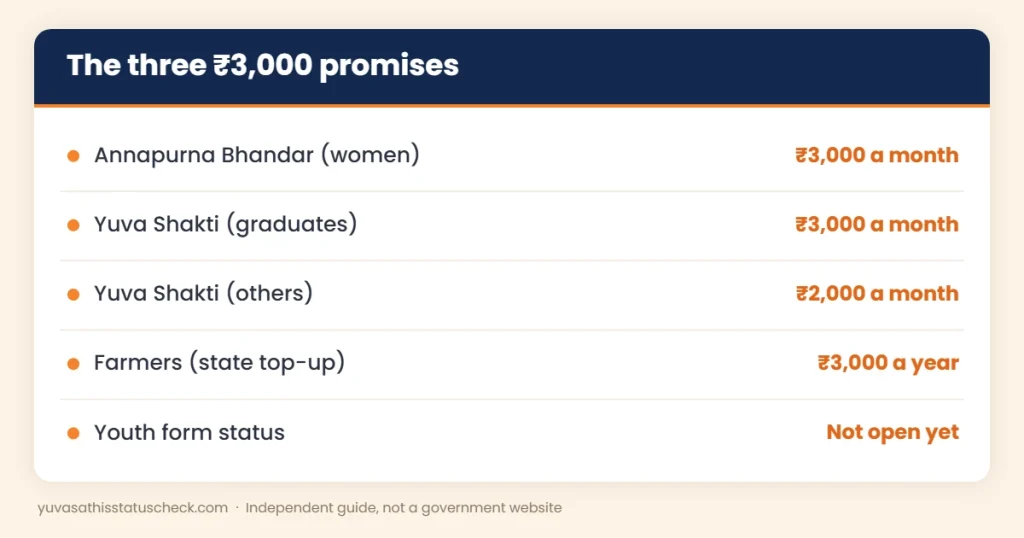
So, in the youth part of the BJP 3000 scheme, only graduates get ₹3,000. Others get ₹2,000. This is why graduates should keep their final marksheet and degree or provisional certificate ready, as reports say degree proof will decide the higher level. For details, read our Yuva Shakti scheme guide and the Bhorsha Karmasuchi explainer.
Part 3: ₹3,000 a year for farmers
The 2026-27 budget also announced that farmer families will get ₹3,000 a year from the state on top of the central PM-KISAN payment. This is a yearly amount, not monthly, so it is much smaller than the other two parts of the BJP 3000 scheme. It is still worth knowing if your family farms, because it adds to the money already received from the central government each year.
How the three parts differ in practice
The three parts are run by different departments and reach people in different ways. The women’s scheme works through its own enrolment and verification, often with help camps. The youth allowance will need a separate online or camp application once its portal opens, with checks on education, age, income and employment. The farmers’ top-up follows farmer records. So applying for one does not mean you are registered for the others, and a problem in one scheme does not affect the others.
If someone in your family qualifies for more than one part, keep a separate file for each scheme with copies of forms, acknowledgements and bank SMS. This makes it much easier to follow up if a payment is delayed.
Monthly vs yearly: do not get confused
A common mistake is to think every ₹3,000 promise is monthly. Here is the difference:
| Scheme | ₹3,000 per… | Yearly total |
|---|---|---|
| Annapurna Bhandar | Month | ₹36,000 |
| Yuva Shakti (graduates) | Month | ₹36,000 |
| Yuva Shakti (others) | ₹2,000 per month | ₹24,000 |
| Farmers’ top-up | Year | ₹3,000 |
Who can get which part of the BJP 3000 scheme?
Use this simple guide to see which part may apply to you:
- A woman aged 21 to 60 who meets Annapurna’s rules: Annapurna Bhandar.
- An unemployed graduate aged 21 to 45 from a low-income family: Yuva Shakti at ₹3,000 (when the form opens).
- An unemployed Madhyamik or HS pass person aged 21 to 45 from a low-income family: Yuva Shakti at ₹2,000.
- A farmer family: the state’s yearly top-up to PM-KISAN.
Can one person get both Annapurna and Yuva Shakti?
This is a common question about the BJP 3000 scheme, especially from young unemployed women. Reports say Yuva Shakti will not be given to people already getting another similar social protection allowance. That suggests one person may not get both, but the final rule will be in the Yuva Shakti guidelines. Wait for the official notice before you decide which one to apply for.
Can two people in one family benefit?
Different people in the same family may qualify for different schemes, for example a mother under Annapurna and a son or daughter under Yuva Shakti. But Yuva Shakti reportedly has a family income limit of ₹1 lakh a year, so family income will matter.
Who is not covered
Based on reported rules, these groups are unlikely to get the monthly ₹3,000:
- Government employees and their families, for Annapurna Bhandar, as reported.
- Women outside the reported 21 to 60 age group, for Annapurna Bhandar.
- Youth with a regular salaried job, for Yuva Shakti.
- Youth from families with income above ₹1 lakh a year, for Yuva Shakti.
- Non-graduates hoping for ₹3,000; they are expected to get ₹2,000.
- People who are not permanent residents of West Bengal.
Each scheme’s final guidelines decide the exact rules, so use this list only as a rough guide.
What changes for old Yuva Sathi applicants
If you applied for the ₹1,500 Yuva Sathi allowance in February 2026, you are not automatically moved to Yuva Shakti. Reports from May 2026 said old and new applicants would have to apply afresh, and the new scheme adds an income limit. Keep your old application number, but plan to apply again when the new form opens.
Timeline of the BJP 3000 scheme promises
| Date | Event |
|---|---|
| April–May 2026 | ₹3,000 promises made in the election campaign |
| 9 May 2026 | New Chief Minister sworn in |
| June 2026 | Annapurna Bhandar rollout begins, as reported |
| 22 June 2026 | Budget 2026-27 puts the promises into numbers |
| November 2026 | Yuva Shakti form expected (not confirmed) |
BJP 3000 scheme: old vs new schemes
| Old scheme | Old amount | New scheme | New amount |
|---|---|---|---|
| Lakshmir Bhandar | ₹1,500–1,700 a month | Annapurna Bhandar | ₹3,000 a month |
| Banglar Yuva Sathi | ₹1,500 a month | Yuva Shakti | ₹3,000 / ₹2,000 a month |
For the youth side, our Yuva Shakti vs Yuva Sathi comparison has more detail.
4 real-life examples
Shampa, 34, homemaker, Howrah: She was getting Lakshmir Bhandar. Under the new system, she is covered by Annapurna Bhandar and gets ₹3,000 a month in her bank account, as long as she meets the scheme’s rules.
Rahul, 25, BCom graduate, unemployed, Nadia: His family income is about ₹80,000 a year. He expects to qualify for ₹3,000 a month under Yuva Shakti once the form opens.
Tania, 23, HS pass, unemployed, Malda: She may qualify for ₹2,000 a month under Yuva Shakti, not ₹3,000, because she is not a graduate.
Biswajit, 48, farmer, Purba Bardhaman: He is too old for Yuva Shakti, but his family can get the state’s ₹3,000 yearly top-up along with PM-KISAN. These four cases show why the BJP 3000 scheme is not one payment for everyone.
How DBT payments work
All of these schemes pay through Direct Benefit Transfer (DBT). This means:
- The department approves your application.
- The money is sent using your Aadhaar number or bank details.
- It reaches the bank account that is linked with your Aadhaar for DBT.
- You usually get an SMS from your bank when the money arrives.
If your Aadhaar is linked to an old or closed account, the payment can fail or go to the wrong account. That is why checking your Aadhaar seeding status before applying is one of the most useful things you can do.
Common mistakes to avoid
- Thinking the farmers’ ₹3,000 is monthly; it is yearly.
- Assuming every unemployed person gets ₹3,000; non-graduates get ₹2,000.
- Applying through unofficial websites or agents.
- Using a bank account in someone else’s name.
- Hiding family income or a job; wrong declarations can lead to rejection and recovery of money.
- Not keeping a copy of the acknowledgement after applying.
How to apply for the BJP 3000 scheme
There is no single “BJP 3000 scheme form”. You apply for each scheme separately:
- Annapurna Bhandar: apply through the official process announced by the department for women, usually via government camps or the official portal.
- Yuva Shakti: wait for the official portal; the form had not opened as of 3 November 2026. Our Yuva Shakti online apply page will carry the link once it is live.
- Farmers’ top-up: follows the farmer records used for state and central farm schemes.
If anyone offers you a “BJP 3000 scheme form” for money, it is a scam.
Documents to keep ready
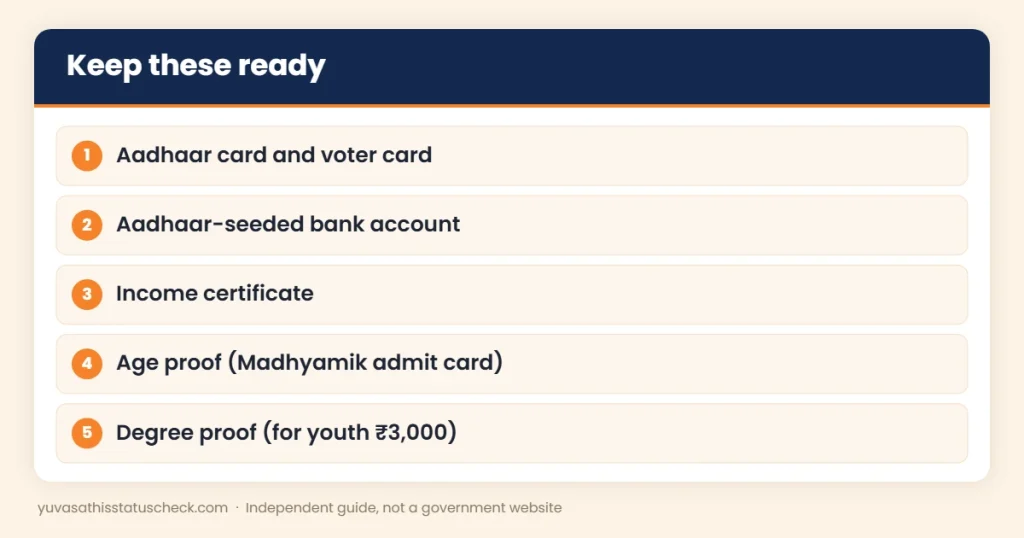
Most parts of the BJP 3000 scheme ask for similar papers:
- Aadhaar card and voter card.
- Bank account in your own name, seeded with Aadhaar; see our DBT link guide.
- Income certificate; see our income certificate West Bengal guide.
- Age proof, such as a Madhyamik admit card or birth certificate.
- Degree certificate or provisional certificate, for the ₹3,000 youth level.
- Caste certificate, if applicable.
Where the BJP 3000 scheme stands today
| Part | Status as of 3 November 2026 |
|---|---|
| Annapurna Bhandar | Rolled out, as reported |
| Yuva Shakti | No official form yet; reports suggest November 2026 |
| Farmers’ top-up | Announced in the budget |
For the full list of budget promises, see our West Bengal budget 2026 summary.
Not eligible? Other support to check
If you do not qualify for any part, other schemes may still help:
- Schoolgirls: Kanyashree continues, with a higher K1 amount announced for 2027; see our Kanyashree Prakalpa update.
- College girls: the budget announced a ₹50,000 one-time grant for unmarried girls joining undergraduate courses in government and aided colleges.
- Exam aspirants: free coaching centres and a one-time grant were announced.
- Job seekers: registering on the Employment Bank helps you find vacancies; see our Employment Bank registration guide.
- Everyone: compare the older and newer allowances in our bekar bhata guide.
How to check that the money has arrived
- Check your bank passbook or mini statement at an ATM.
- Look for an SMS from your bank on your registered mobile.
- Use your bank’s mobile app or net banking.
- If you expected money but nothing came, first check your Aadhaar seeding, then contact the office that handles the scheme.
Beware of BJP 3000 scheme scams
The words “BJP 3000 scheme” are often used in fake messages and videos. Protect yourself:
- There is no official website called “BJP 3000 scheme”.
- Do not fill forms on sites that ask for a fee or your bank PIN.
- Do not trust WhatsApp messages that say “₹3,000 credited, click to claim”.
- Never share an OTP with anyone.
- Use only official government websites ending in .gov.in.
- Report fraud on 1930 or at cybercrime.gov.in.
Key points to remember
- The BJP 3000 scheme is not one scheme; it is a group of ₹3,000 promises.
- Annapurna Bhandar pays ₹3,000 a month to eligible women.
- Yuva Shakti pays ₹3,000 a month only to graduates; others get ₹2,000.
- The farmers’ ₹3,000 is yearly, not monthly.
- The Yuva Shakti form had not opened as of 3 November 2026.
- Never pay anyone to apply.
Frequently asked questions
What is the BJP 3000 scheme?
It is a popular name for the ₹3,000 promises made by the BJP in West Bengal: ₹3,000 a month for eligible women under Annapurna Bhandar and ₹3,000 a month for unemployed graduates under Yuva Shakti.
Is the BJP 3000 scheme one single scheme?
No. It covers separate schemes with their own rules and forms.
Do all unemployed youth get ₹3,000?
No. Graduates are to get ₹3,000 a month, while other eligible educated youth are to get ₹2,000 a month.
Has the Yuva Shakti part started?
Not yet. As of 3 November 2026, the form had not opened.
Who gets Annapurna Bhandar?
Eligible women, reported as aged 21 to 60, under the department’s rules. It replaced Lakshmir Bhandar.
Is the farmers’ ₹3,000 monthly?
No. It is ₹3,000 a year, paid by the state on top of PM-KISAN.
Can I get both Annapurna and Yuva Shakti?
Reports say Yuva Shakti will not go to people already getting a similar allowance, so it may not be possible. Wait for the official rules.
Is there a fee to apply?
No. Government forms are free. Anyone asking for money is a scammer.
Sources we checked
- PRS Legislative Research: West Bengal Budget 2026-27: Annapurna ₹3,000, ₹36,000 crore, farmers’ ₹3,000.
- Sarkari Yojana: new schemes in West Bengal: Annapurna age group and rollout, Yuva Shakti status.
- GovtSchemes.in: Bhorsha Karmasuchi: youth amounts, age and income rules.
- India Hood Bangla, 28 October 2026: Yuva Shakti form not yet open.
Disclaimer: yuvasathisstatuscheck.com is an independent information website. It is not connected with the Government of West Bengal or any political party. Always confirm details in official notices.