Krishak Bandhu 2026: Renamed Mukhyamantri Kisan Samman Nidhi – New ₹6,000/₹4,000 Rates, ₹3,000 PM-KISAN Top-Up & Status Check
Last checked: 9 November 2026. Krishak Bandhu has been West Bengal’s best-known scheme for farmers. In October 2026, the state government gave it a new name and new payment rules. Krishak Bandhu is now called Mukhyamantri Kisan Samman Nidhi, and it has two parts: one for farmers who are not under PM-KISAN, and a ₹3,000 top-up for those who are.
This guide explains what changed in Krishak Bandhu, the new amounts, who is left out, how the first payment was planned, how to check status and what new farmers should do to apply.
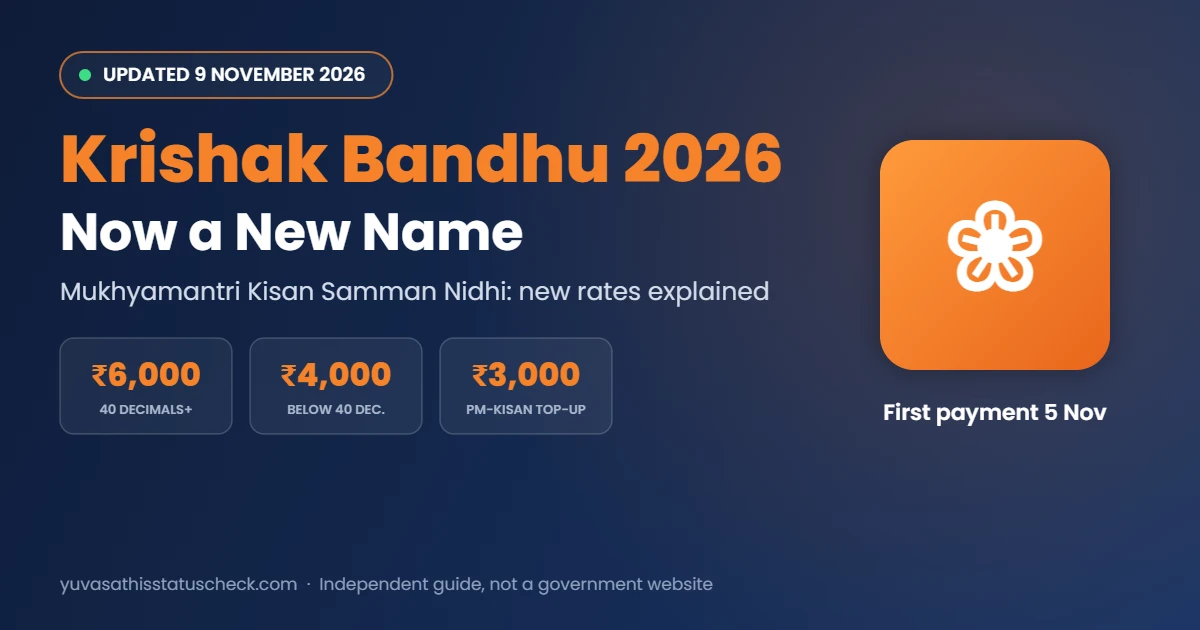
Quick answer: In late October 2026, Krishak Bandhu was renamed Mukhyamantri Kisan Samman Nidhi. Farmers outside PM-KISAN get ₹6,000 a year (40 decimals of land or more) or ₹4,000 a year (below 40 decimals). PM-KISAN farmers get an extra ₹3,000 a year from the state. A ₹2,000 payment to about 48 lakh farmers was announced for 5 November 2026 from Pursurah, Hooghly.
Scheme at a glance
| Point | Details |
|---|---|
| Old name | Krishak Bandhu (Natun) |
| New name | Mukhyamantri Kisan Samman Nidhi |
| Department | Agriculture Department, Government of West Bengal |
| Component 1 | ₹6,000 or ₹4,000 a year for farmers outside PM-KISAN |
| Component 2 | ₹3,000 a year extra for PM-KISAN farmers |
| Payment mode | Direct Benefit Transfer (DBT) to an Aadhaar-linked bank account |
| Who applies | New farmers, through the block agriculture office |
| Official website | krishakbandhu.wb.gov.in |
What is Krishak Bandhu?
Krishak Bandhu is a West Bengal scheme that gives yearly cash support to farmers and recorded sharecroppers. Under the older version, called Krishak Bandhu (Natun), farmers with one acre or more got up to ₹10,000 a year in two instalments, and smaller farmers got a proportionate amount, with a minimum of ₹4,000. The scheme also had a death benefit for the families of farmers.
For years, the state did not join the central PM-KISAN scheme, and Krishak Bandhu was the main support for farm families. That changed after the new government took office in May 2026.
What changed in Krishak Bandhu in 2026?
Here is the timeline of the change, as reported:
| Date | What happened |
|---|---|
| 22 June 2026 | Budget 2026-27 announces ₹3,000 a year for farmer families on top of PM-KISAN |
| 21 October 2026 | Cabinet approval for the revised scheme, as reported |
| 28 October 2026 | Government announces the new name, Mukhyamantri Kisan Samman Nidhi |
| 5 November 2026 | ₹2,000 payment announced for about 48 lakh farmers from Pursurah, Hooghly |
So Krishak Bandhu is not closed. It has been renamed and redesigned. Reports say the official portal now shows the new name.
Krishak Bandhu new rates: Component 1 and Component 2
The renamed Krishak Bandhu has two parts.
Component 1: for farmers not under PM-KISAN
| Land held | Yearly amount | Paid as |
|---|---|---|
| 40 decimals or more | ₹6,000 | Two instalments (Kharif and Rabi) |
| Below 40 decimals | ₹4,000 | Two instalments (Kharif and Rabi) |
Component 2: top-up for PM-KISAN farmers
Farmers who already get ₹6,000 a year from the central PM-KISAN scheme do not get Component 1. Instead, the state adds ₹3,000 a year, reported to be paid in three instalments of ₹1,000. With PM-KISAN, that makes ₹9,000 a year.
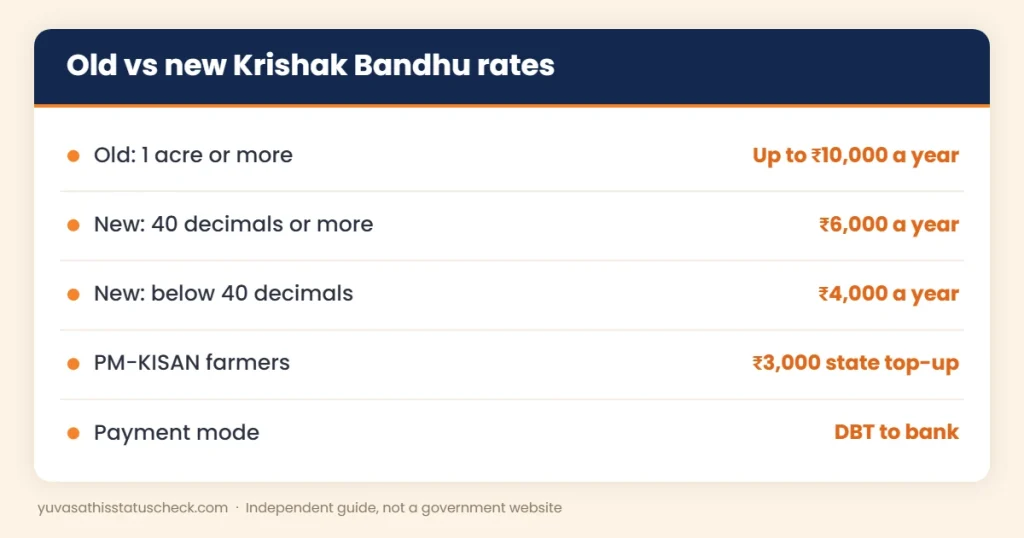
Old vs new: what is the difference?
| Point | Old Krishak Bandhu (Natun) | New Krishak Bandhu (Mukhyamantri Kisan Samman Nidhi) |
|---|---|---|
| Top amount | Up to ₹10,000 a year (1 acre or more) | ₹6,000 a year (40 decimals or more) |
| Minimum | ₹4,000 a year | ₹4,000 a year (below 40 decimals) |
| PM-KISAN farmers | Not linked | ₹3,000 a year state top-up |
| Payment | DBT in two instalments | DBT; Component 1 in two, Component 2 in three instalments |
The highest amount under Component 1 is lower than the old ₹10,000, but PM-KISAN farmers can now get ₹9,000 in total from both governments.
Who can get Krishak Bandhu now?
Based on reports on the new guidelines, eligible farmers must:
- Be permanent residents of West Bengal.
- Own or cultivate land in the state, as a landowner, registered bargadar, patta holder or recorded sharecropper.
- Have land possession as on 1 July 2026, as reported.
- Have an Aadhaar-linked, DBT-enabled bank account.
- Be the only beneficiary from the farming family; one member per family can get the benefit.
Who is left out of Krishak Bandhu?
Reports list these exclusions:
- Land registered in the name of an institution or organisation.
- PM-KISAN beneficiaries (they get the ₹3,000 top-up instead of Component 1).
- Doctors, engineers, lawyers, chartered accountants and architects who are registered and practising.
- Income tax payers.
- Pensioners (reported as those with ₹10,000 or more a month).
- Government employees and constitutional post holders, except Group D, MTS and Class IV staff.
- Non-resident Indians.
- People who cannot give valid Aadhaar details.
Reports also say people removed from the voter list during the 2026 special revision as dead, shifted or absent are not eligible.
PM-KISAN in short, for West Bengal farmers
Because the state top-up is linked with PM-KISAN, it helps to know how the central scheme works:
- PM-KISAN pays ₹6,000 a year in three instalments of ₹2,000 to eligible landholding farmer families.
- Registration is done on the PM-KISAN portal, at a Common Service Centre or through the state’s nodal officers.
- e-KYC and Aadhaar-linked land records are needed to keep getting instalments.
- The “Know Your Status” option on the portal shows each instalment and any reason for holding it.
- Many farmers in West Bengal who registered after the state joined PM-KISAN can now get the central amount plus the ₹3,000 state top-up.
If you are not yet registered for PM-KISAN, compare both options with the block agriculture officer. A farmer with less than 40 decimals may get more in total through PM-KISAN plus the top-up (₹9,000) than through Component 1 alone (₹4,000).
The 5 November 2026 payment
Reports said a payment of ₹2,000 was to be sent to about 48 lakh farmers on 5 November 2026 from Pursurah in Hooghly. Some reports described it as the first instalments of the ₹3,000 top-up for PM-KISAN farmers. Check your bank SMS or passbook to see whether you received it.
Do old Krishak Bandhu farmers need to apply again?
No, according to reports. Existing Krishak Bandhu beneficiaries are moved to the new scheme automatically, as long as their land and bank details pass verification. Keep your land papers and bank account up to date so the verification goes smoothly.
How to apply for Krishak Bandhu as a new farmer
New farmers can apply through the block agriculture office:
- Collect the prescribed application form from your block’s Assistant Director of Agriculture (ADA) office.
- Fill in your details, land information and bank account.
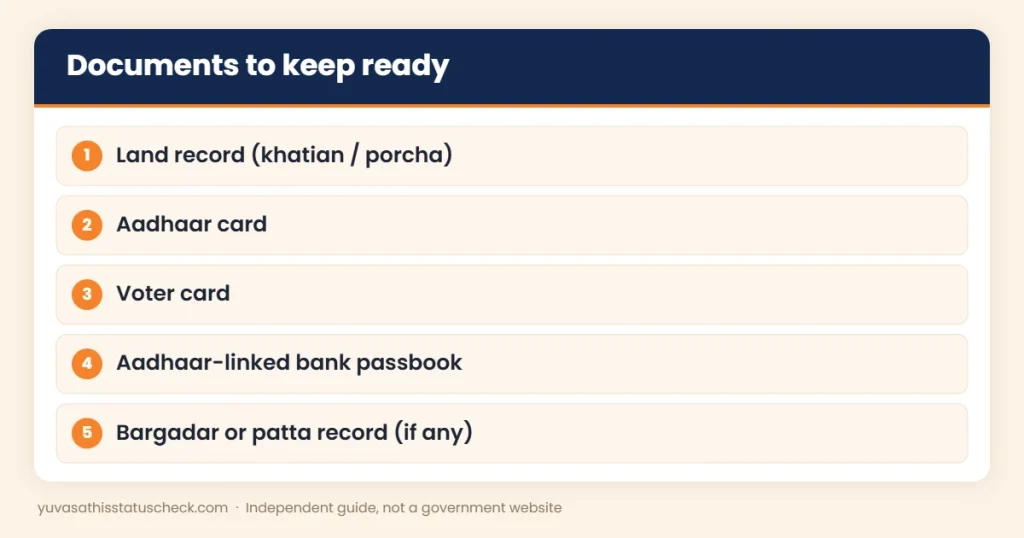
- Attach copies of your land record, Aadhaar, voter card and bank passbook.
- Submit the form at the block office and keep the receipt.
- The block and district offices check the application, and approved farmers get a beneficiary number.
Government help camps are also planned in many areas; see our Jan Kalyan Shivir guide.
How land in decimals works
In West Bengal, land is usually written in decimals (also called “satak”). This matters because the new rate depends on the 40-decimal mark.
| Land in decimals | Same land in acres | Yearly amount under Component 1 |
|---|---|---|
| 100 decimals | 1 acre | ₹6,000 |
| 60 decimals | 0.6 acre | ₹6,000 |
| 40 decimals | 0.4 acre | ₹6,000 |
| 39 decimals | 0.39 acre | ₹4,000 |
| 20 decimals | 0.2 acre | ₹4,000 |
| 5 decimals | 0.05 acre | ₹4,000 |
One acre is 100 decimals, and one bigha is roughly 33 decimals in most parts of the state. Check the total area written on your khatian or porcha. If your family land is split among several members, the area recorded in the name of the applicant is what the department is likely to count.
When will the instalments come?
The government has not published a fixed date for every instalment. Based on how the older scheme worked and what has been reported so far:
- Component 1 is paid in two parts, one around the Kharif season (roughly May to July) and one around the Rabi season (roughly November to January).
- Component 2, the ₹3,000 top-up, is reported to be paid in three parts of ₹1,000, which may follow the PM-KISAN cycle.
- The first payment under the new name was announced for 5 November 2026.
- Exact dates are usually announced by the state government a few days in advance through news reports and official press notes.
If an instalment is announced but you do not get the money within a week or two, first check your bank account, then contact the block office.
How to check whether the money reached your bank
You do not always need to visit the portal to know whether the money came. Try these simple ways:
- Bank SMS: If your mobile number is linked with your bank, you will get an SMS when money is credited. DBT credits usually show a short code of the department.
- Passbook update: Visit your branch or a passbook printing machine and update your passbook.
- Mini statement: Use an ATM, a bank mitra or customer service point to take a mini statement.
- Mobile banking or UPI app: Check the balance and recent transactions in your bank’s app.
- PFMS website: The central Public Financial Management System site lets you check DBT payments using your bank name and account number, for many schemes.
Keep a note of the date and amount you received. It will help if you ever need to raise a complaint.
How to update your bank account or Aadhaar seeding
Many payments fail because the bank account is not linked with Aadhaar or is not enabled for DBT. Here is what you can do:
- Visit the branch where you have your account with your Aadhaar card and passbook.
- Ask the bank to seed your Aadhaar with the account and to enable it for DBT (sometimes called NPCI mapping).
- Fill in the consent form the bank gives you and sign it.
- Wait for two to five working days and then check the status again with the bank.
- If you changed your bank account, inform the block agriculture office in writing with a copy of the new passbook.
Our Yuva Shakti DBT link guide explains Aadhaar seeding in more detail, and the same steps work for farmer payments.
Bargadars, patta holders and sharecroppers
The scheme has always included more than landowners. Registered bargadars (sharecroppers with recorded rights) and patta holders who cultivate government land were covered under the old scheme. Reports on the new guidelines also mention landowners, registered bargadars, patta holders and recorded sharecroppers as eligible groups.
If you are a sharecropper without a recorded name, ask at the Block Land and Land Reforms Office (BL&LRO) about getting your name recorded. Without a recorded right, it is hard to prove that you cultivate the land.
What about the farmer death benefit?
Under the older scheme, the family of a farmer between 18 and 60 years who died got a one-time grant of ₹2 lakh. Reports on the renamed scheme so far focus on the yearly payments, and we have not found a clear official notice on whether the death benefit continues in the same form. If a farmer in your family has died, contact the block agriculture office and ask about the current rules before the time limit runs out.
Tips to avoid rejection
- Make sure the name on your land record, Aadhaar and bank account is spelled the same way.
- Keep your khatian or porcha updated after any land transfer or inheritance.
- Apply from only one member of the family.
- Do not apply under Component 1 if you already get PM-KISAN; the top-up is the right benefit for you.
- Keep photocopies and the receipt of every form you submit.
- Answer calls or visits from the agriculture department staff during verification.
- Check that your name is on the current voter list.
Krishak Bandhu status check
To check your Krishak Bandhu status:
- Open the official portal, krishakbandhu.wb.gov.in.
- Look for the option to see registered farmer information or status.
- Enter the details asked, such as your Aadhaar number or beneficiary ID.
- View your registration and payment details.
For PM-KISAN status, use the official PM-KISAN portal and its “Know Your Status” option.
Be careful: some old websites with Krishak Bandhu in their name are not government sites. Use only addresses ending in .wb.gov.in or .gov.in.
Common Krishak Bandhu problems and fixes
| Problem | Likely reason | What to do |
|---|---|---|
| Money not received | Bank not seeded with Aadhaar | Check Aadhaar seeding; see our DBT link guide |
| Name missing after renaming | Verification of land or bank details pending | Visit the block ADA office with papers |
| Getting ₹3,000 instead of ₹6,000 | You are a PM-KISAN beneficiary | This is the rule; you get PM-KISAN plus the top-up |
| Rejected | Excluded category or mismatch in records | Ask the block office for the reason |
| Two family members applied | Only one per family is allowed | Keep one application |
Krishak Bandhu and other new state schemes
The change to Krishak Bandhu is part of a wider shift in state schemes after the 2026-27 budget. For example, Annapurna Bhandar pays ₹3,000 a month to eligible women, and a new allowance of ₹3,000 or ₹2,000 a month is planned for unemployed youth. Read our West Bengal budget 2026 summary and the BJP 3000 scheme explainer for the full picture.
Helpline and office contacts
| Contact | Details |
|---|---|
| Scheme helpline | 033-2357-0021 (office hours), as listed for the scheme |
| Additional helpline | 98303-83383, as reported |
| Block office | Assistant Director of Agriculture (ADA), your block |
| Land records | Block Land and Land Reforms Office (BL&LRO) |
| PM-KISAN helpline | 155261 or 011-24300606 |
When you call, keep your Aadhaar number, beneficiary ID (if you have one) and bank details ready.
Frequently asked questions
Is Krishak Bandhu closed?
No. In October 2026 it was renamed Mukhyamantri Kisan Samman Nidhi and redesigned with new rates.
How much does the new Krishak Bandhu pay?
₹6,000 a year for 40 decimals of land or more and ₹4,000 a year below 40 decimals, for farmers not under PM-KISAN.
What do PM-KISAN farmers get?
A state top-up of ₹3,000 a year, reported to be paid in three ₹1,000 instalments, on top of PM-KISAN’s ₹6,000.
Do old Krishak Bandhu farmers need to reapply?
Reports say no. They are moved automatically if their land and bank details are verified.
Where do new farmers apply?
At the block Assistant Director of Agriculture office, with land records, Aadhaar, voter card and bank details.
How many members of a family can get Krishak Bandhu?
Only one eligible member per farming family.
How do I check my Krishak Bandhu status?
On the official portal, krishakbandhu.wb.gov.in, using the status or registered farmer information option.
Is 40 decimals the same as 0.4 acre?
Yes. One acre is 100 decimals, so 40 decimals is 0.4 acre. Farmers with this much land or more get ₹6,000 a year under Component 1.
Why did my payment not come?
Common reasons are an Aadhaar-unseeded bank account, pending land verification or falling in an excluded group. Check your bank first, then the block office.
What is the Krishak Bandhu helpline?
The number listed for the scheme is 033-2357-0021, during office hours.
Sources we checked
- Aajkaal, 28 October 2026: renaming and 5 November payment.
- Asianet News Bangla, 31 October 2026: ₹6,000/₹4,000 rates, exclusions, how to apply.
- GovtSchemes.in: Mukhyamantri Krishak Samman Nidhi: components, top-up, eligibility and helplines.
- PRS Legislative Research: West Bengal Budget 2026-27: ₹3,000 yearly top-up on PM-KISAN.
Disclaimer: yuvasathisstatuscheck.com is an independent information website. It is not connected with the Government of West Bengal. Always confirm details on the official portal or at your block agriculture office.
3 Comments