Sikshashree 2026-27: SC & ST Scholarship for Class V to VIII – Amount, Eligibility, Documents & How to Apply
Last checked: 9 November 2026. Sikshashree (also written Shikshashree) is a West Bengal scholarship for SC and ST students in Classes V to VIII. It gives a small yearly grant to day scholars so that children from Scheduled Caste and Scheduled Tribe families stay in school and buy books and other study material.
For 2026-27, registration through schools was reported to have started on 1 June 2026. This guide explains Sikshashree eligibility, the amount for each class, how schools apply, documents, renewal, status check and answers to common questions from parents.
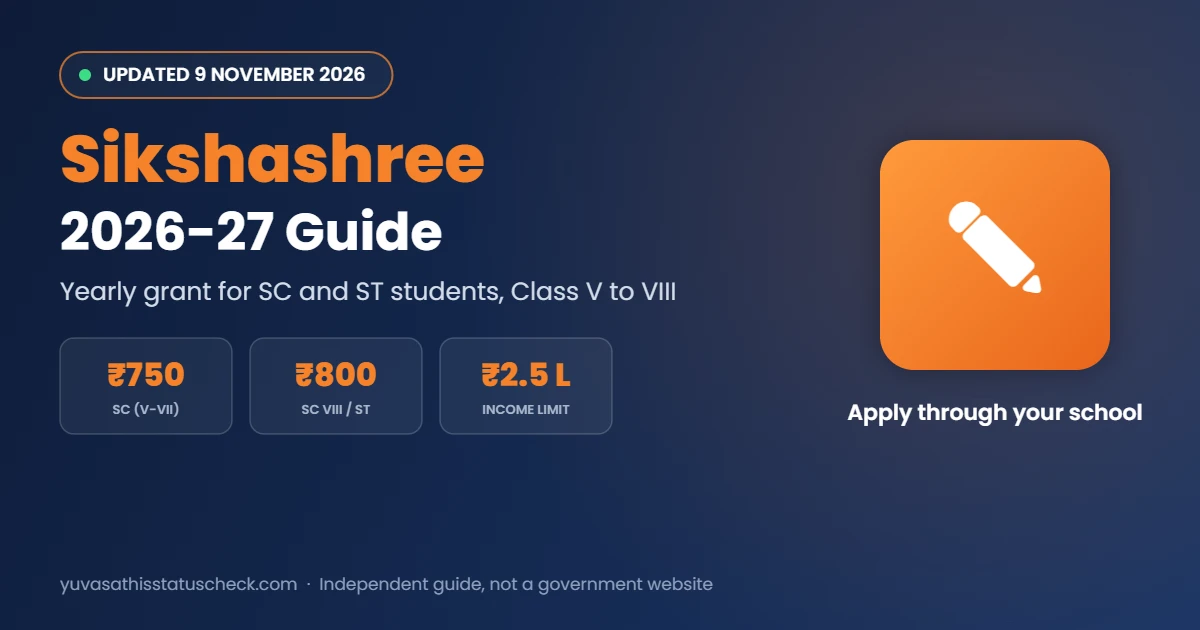
Quick answer: Sikshashree is for SC and ST day scholars in Classes V to VIII at government, government-aided and recognised schools in West Bengal, with a family income up to ₹2.5 lakh a year. SC students get ₹750 a year in Classes V to VII and ₹800 in Class VIII; ST students get ₹800 a year. Parents apply through the school, and the Head Master uploads and approves the application online. The money is paid by DBT.
Sikshashree at a glance
| Point | Details |
|---|---|
| Scheme name | Sikshashree (Shikshashree) |
| Departments | Backward Classes Welfare (SC) and Tribal Development (ST) |
| For | SC and ST students in Classes V to VIII |
| Student type | Day scholars only (not hostellers) |
| Income limit | ₹2.5 lakh a year (family) |
| SC amount | ₹750 a year (Class V to VII), ₹800 (Class VIII) |
| ST amount | ₹800 a year (Class V to VIII) |
| How to apply | Through the school (online entry by the Head Master) |
| Payment | DBT to an Aadhaar-seeded bank account |
| 2026-27 registration | Reported open from 1 June 2026 |
What is Sikshashree?
Sikshashree is a state scheme that combined two older benefits for SC students, the Book Grant and the Maintenance Grant, into a single yearly payment. The goal is simple: help SC and ST children in the upper primary years (Classes V to VIII) continue their studies and reduce dropouts, especially among girls.
The grant is small, but it reaches lakhs of students every year. It is paid straight into a bank account, so families can use it for books, stationery, school bags and other needs. The scheme is run by the Backward Classes Welfare Department for SC students and the Tribal Development Department for ST students, and the school acts as the link between the family and the department.
Why this grant matters
Classes V to VIII are the years when many children from poor families leave school, either to help at home or to start working. A yearly grant, even a small one, helps parents pay for books, uniforms and travel and shows that the state supports the child’s education. For girls, regular attendance in these years also makes it easier to continue to Class IX and beyond, where larger scholarships and the girls’ scheme can help.
Who is eligible for Sikshashree?
A student can get Sikshashree if:
- The student belongs to a Scheduled Caste or Scheduled Tribe.
- The family lives permanently in West Bengal.
- The student is studying in Class V, VI, VII or VIII.
- The student is a day scholar (lives at home, not in a hostel).
- The school is a government, government-aided or government-recognised school in the state.
- The family’s yearly income is ₹2.5 lakh or less.
- The student is not getting any other central or state scholarship for the same year.
Students who stay in hostels are not covered by Sikshashree; they may get support under separate hostel schemes of the department.
Sikshashree amount by class
| Class | SC students | ST students |
|---|---|---|
| Class V | ₹750 a year | ₹800 a year |
| Class VI | ₹750 a year | ₹800 a year |
| Class VII | ₹750 a year | ₹800 a year |
| Class VIII | ₹800 a year | ₹800 a year |
The amount is paid once a year. If a student fails and repeats a class, the grant is usually not paid again for that same class.
How much a student gets over four years
If a student gets the grant every year from Class V to Class VIII without repeating a class, the total works out like this:
| Student | Class V to VII | Class VIII | Total over four years |
|---|---|---|---|
| SC student | ₹750 x 3 = ₹2,250 | ₹800 | ₹3,050 |
| ST student | ₹800 x 3 = ₹2,400 | ₹800 | ₹3,200 |
The amounts are small, but they arrive every year and need no repayment. Families often use the money at the start of the session for new books, notebooks, a school bag or shoes, which helps the child begin the year well.
Sikshashree 2026-27 dates
| Event | Date |
|---|---|
| Registration through schools | Reported open from 1 June 2026 |
| School upload and approval | Ongoing during the session |
| Last date | Not officially confirmed; some guides mentioned around 31 October 2026 |
| Payment | After approval, by DBT |
Because the school handles the online entry, parents should submit the form and documents to the school as early as possible. If you have not yet given the form, ask the Head Master whether entries are still being accepted.
How to apply for Sikshashree
Parents do not apply on a website themselves. The process runs through the school:
- Collect the Sikshashree form from the school office or the class teacher.
- Fill in the student’s details, family income and bank account details.
- Sign the form (student and parent or guardian).
- Attach self-attested copies of the documents listed below.
- Submit the form to the school before the school’s deadline.
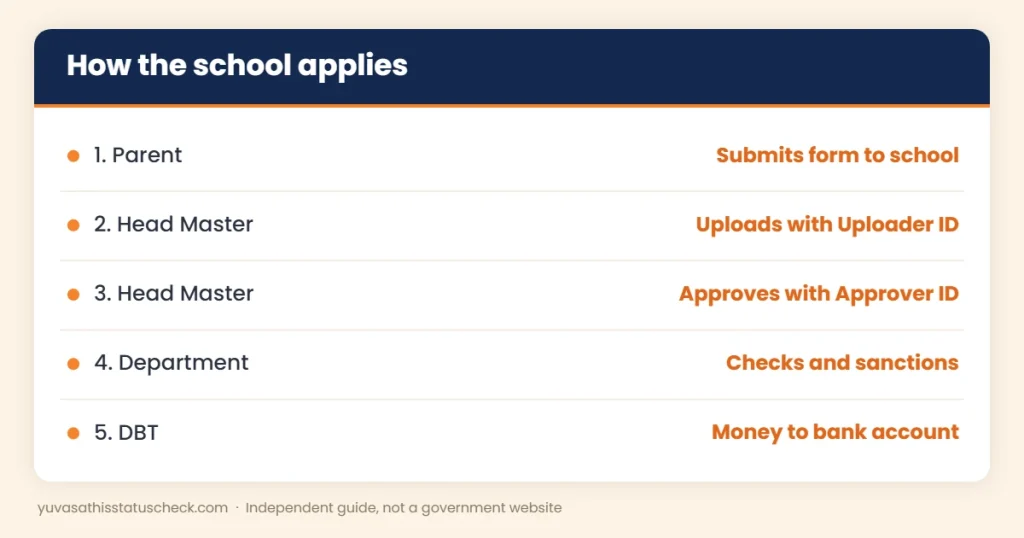
- The Head Master or Teacher-in-Charge enters the data online using the school’s Uploader ID.
- The Head Master then approves the entries using the Approver ID.
- The department checks the data and sends the money by DBT.
Keep a photocopy of the filled form and ask the school for a receipt or acknowledgement.
Documents needed for Sikshashree
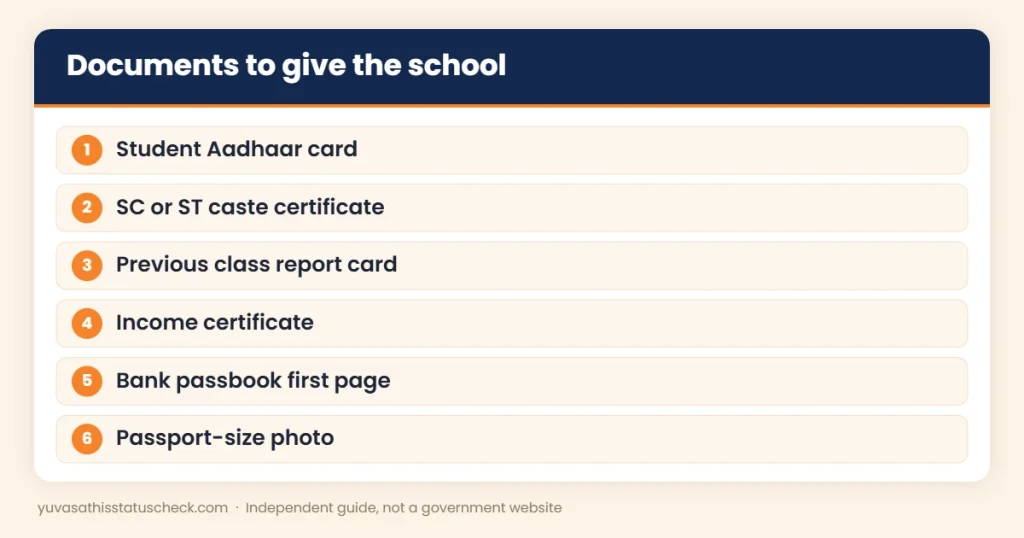
- Student’s Aadhaar card.
- SC or ST caste certificate (of the student or, where allowed, of the parent while the student’s certificate is being processed).
- Mark sheet or report card of the previous class.
- Family income certificate or income declaration from a competent authority.
- Bank passbook first page showing the account number and IFSC.
- Passport-size photo of the student.
- School bonafide or enrolment certificate, if the school asks.
If your child does not yet have a caste certificate, apply early using our caste certificate guide. For income proof, see our income certificate guide.
How to get a caste certificate for your child
A valid SC or ST certificate is the key document. If your child does not have one:
- Apply online on the state caste certificate portal or at the SDO office (for urban areas) or BDO office (for rural areas).
- Attach the parent’s caste certificate, if available, along with residence proof and the child’s birth certificate.
- Attend the enquiry or hearing if one is called.
- Download or collect the certificate once it is approved.
Applying early in the school year helps, because the certificate can take a few weeks. Schools sometimes accept a temporary certificate from an authorised person while the final one is being processed, but this depends on the department’s instructions for that year.
Income certificate for school scholarships
For school-level grants, the income certificate or declaration usually comes from a competent local authority such as the Gram Panchayat Pradhan, the ward councillor or an officer named by the department. Ask the school which format it accepts. The income shown should be the total yearly income of the family from all sources. Make sure the name of the parent and the address match the other documents.
Opening a bank account for a minor
Most public sector banks and many post office branches open accounts for children with a parent or guardian:
- Visit the branch with the child’s Aadhaar and birth certificate, and the parent’s Aadhaar and photo.
- Ask for a minor savings account (often zero balance for students).
- Fill in the form with the guardian’s details and sign it.
- Ask the bank to seed Aadhaar and enable the account for DBT.
- Collect the passbook and check that the name is spelled correctly.
Keep the account active by making at least one small deposit or withdrawal now and then, so that DBT credits are not returned.
Bank account for Sikshashree
The grant is paid only by Direct Benefit Transfer. Many banks open zero-balance accounts for minors with a parent as guardian. Make sure:
- The account is active and has had some activity recently.
- The account is linked with the student’s or guardian’s Aadhaar as required by the bank.
- The account is DBT-enabled (mapped in the NPCI system).
- The IFSC and account number on the form are correct.
Our DBT link guide explains how to check and fix Aadhaar seeding at your bank.
How the payment reaches the account
After the school approves the entries, the department checks them in batches. Approved names are sent for payment through the state’s DBT system, and the money is credited to the bank account given in the form. The bank usually sends an SMS to the registered mobile number when the credit arrives. If the credit fails because of a wrong IFSC or an inactive account, the school is usually told, and corrected details can be sent again.
If your child changes school
If your child moves to another school during the year, tell both schools. The old school should not upload the child’s name again, and the new school should check whether the child has already been covered for that year. Carry the transfer certificate, the previous report card and a copy of the form you submitted at the old school, so the new school can verify the details quickly.
Sikshashree renewal
Sikshashree can be received every year from Class V to Class VIII. For each new year:
- Submit a fresh form or renewal details through the school at the start of the session.
- Attach the previous year’s report card showing promotion.
- Give an updated income certificate if the school asks.
- Make sure the bank account is still active.
The grant ends after Class VIII. From Class IX, SC, ST and OBC students can move to pre-matric scholarships on the Oasis scholarship portal.
Sikshashree status check
Because the school enters the data, the easiest way to check is through the school:
- Ask the Head Master or the teacher in charge of scholarships whether your child’s entry was uploaded and approved.
- Note the application or student ID if the school gives one.
- If a tracking option is available on the department portal, use the student ID to see the stage.
- Check the bank account or passbook for the DBT credit after approval.
If there is a long delay, the school can contact the block or subdivisional office of the Backward Classes Welfare or Tribal Development department.
Role of the school
The school plays the main role in Sikshashree. The Head Master or Teacher-in-Charge is responsible for:
- Collecting forms and documents from parents.
- Checking eligibility (class, caste, day scholar status).
- Entering student data online with the Uploader ID.
- Approving the entries with the Approver ID.
- Sharing information about payment with parents.
If a school does not have its login IDs, it should contact the block office of the department.
Checklist for parents
- The child is in Class V, VI, VII or VIII and goes home every day (day scholar).
- You have a valid SC or ST certificate.
- You have an income certificate or declaration as asked by the school.
- The child has an active, DBT-enabled bank account.
- You have given the form and copies to the school and kept a photocopy.
- You have asked the school to confirm that the entry was uploaded and approved.
Tips for Head Masters and teachers
- Start collecting forms early in the session, before the busy exam months.
- Check caste certificates and bank details carefully before entering them online.
- Approve uploaded entries quickly so that they reach the department in time.
- Keep a register of students covered each year, with their bank details.
- Inform parents when payments are released, so they can check their accounts.
- Contact the block office if the school’s login IDs are not working.
Other help for SC and ST students
Besides this grant, SC and ST students in West Bengal can get support from several other schemes. From Class IX, pre-matric scholarships are available through the Oasis portal, and after Class X, post-matric scholarships cover higher studies. The departments also run hostels and give hostel grants for students who live away from home. Students with high marks in Madhyamik can later apply for merit scholarships such as SVMCM.
What parents should avoid
- Do not pay anyone who offers to “get the scholarship” for a fee; the process is free.
- Do not give your bank PIN or OTP to anyone.
- Do not apply for two scholarships for the same year.
- Do not ignore calls or notices from the school about missing documents.
Common problems and fixes
| Problem | What to do |
|---|---|
| Name not uploaded by school | Meet the Head Master with a copy of your form |
| Payment not received | Check bank account status and Aadhaar seeding |
| Caste certificate pending | Ask the school whether a temporary certificate is accepted; apply for the final one quickly |
| Student moved to a hostel | Not eligible for Sikshashree; ask about hostel schemes |
| Class repeated | Grant is usually not paid again for the same class |
| Wrong bank details | Inform the school immediately so the entry can be corrected |
Sikshashree vs other school scholarships
| Scheme | Who it is for | Classes |
|---|---|---|
| Sikshashree | SC and ST day scholars | V to VIII |
| Oasis pre-matric | SC, ST and OBC students | Mainly IX and X |
| Aikyashree pre-matric | Minority community students | I to X |
| Kanyashree K1 | Unmarried girls aged 13 to 18 in education | VIII and above (by age) |
| Taruner Swapna | Class 11 and 12 students | XI and XII |
Minority students should read our Aikyashree scholarship guide, girls can check Kanyashree Prakalpa, and older students can look at Taruner Swapna and the SVMCM scholarship.
Frequently asked questions
What is Sikshashree?
It is a West Bengal scholarship for SC and ST day scholars in Classes V to VIII, paid once a year by DBT.
How much money does Sikshashree give?
SC students get ₹750 a year in Classes V to VII and ₹800 in Class VIII. ST students get ₹800 a year.
What is the income limit?
Family income should be ₹2.5 lakh a year or less.
Can hostel students get Sikshashree?
No. It is only for day scholars.
How do I apply?
Through your child’s school. Submit the form and documents; the Head Master uploads and approves it online.
Is Sikshashree the same as Shikshashree?
Yes. Both spellings refer to the same scheme.
What happens after Class VIII?
The grant ends. From Class IX, SC, ST and OBC students can apply for pre-matric scholarships on the Oasis portal.
Who do I contact for help?
First the school. If needed, the block or subdivisional office of the Backward Classes Welfare or Tribal Development department.
Sources we checked
- West Bengal government scheme page: Shikshashree: purpose, merged grants and eligibility.
- IndiaScholarships: Sikshashree 2026-27: 2026-27 dates, amounts, process and documents.
- Sikshashree guideline for SC students: original scheme guideline.
Disclaimer: yuvasathisstatuscheck.com is an independent information website. It is not connected with the Government of West Bengal. Always confirm details with your school or the department.