Nabanna Scholarship 2026-27: Eligibility, ₹10,000/₹12,000 Amount, Documents, MLA Letter & How to Apply
Last checked: 9 November 2026. The Nabanna scholarship is a West Bengal scholarship paid from the Chief Minister’s Relief Fund for students from poor families who score between 50% and 60%. It is meant for students who just miss the 60% mark needed for the SVMCM scholarship but still need help to continue their studies.
Applications for 2026-27 opened on 16 September 2026 on cmrf.wb.gov.in and are accepted throughout the year. This guide explains Nabanna scholarship eligibility, the amount, documents (including the MLA or MP recommendation letter), how to apply online or by post, status check and helpline numbers.
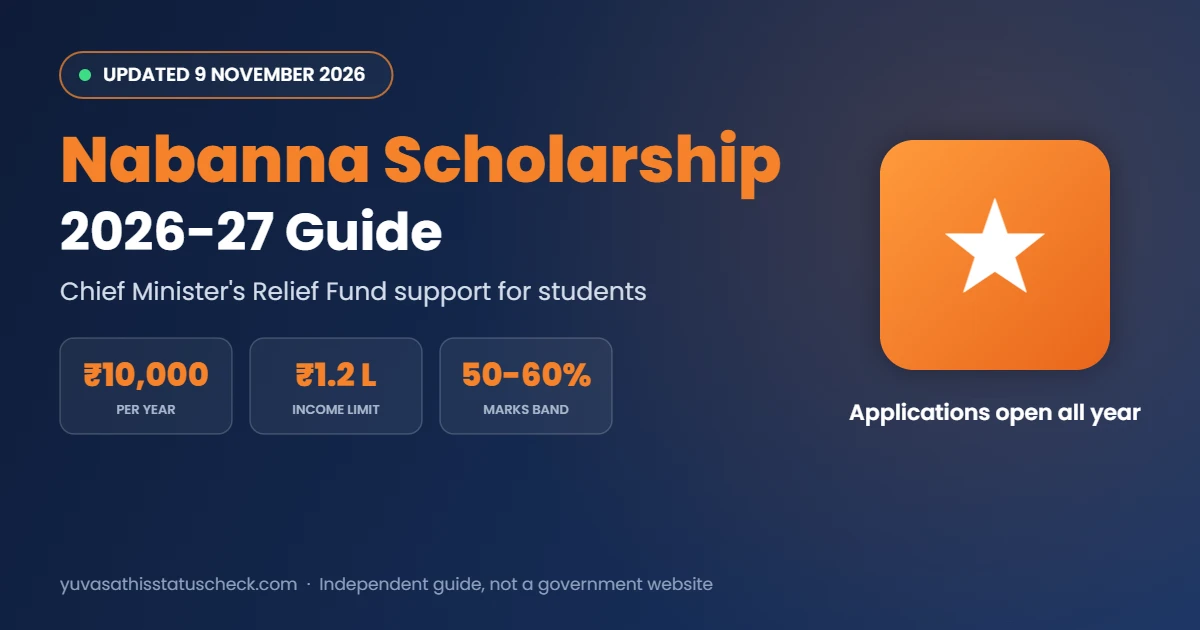
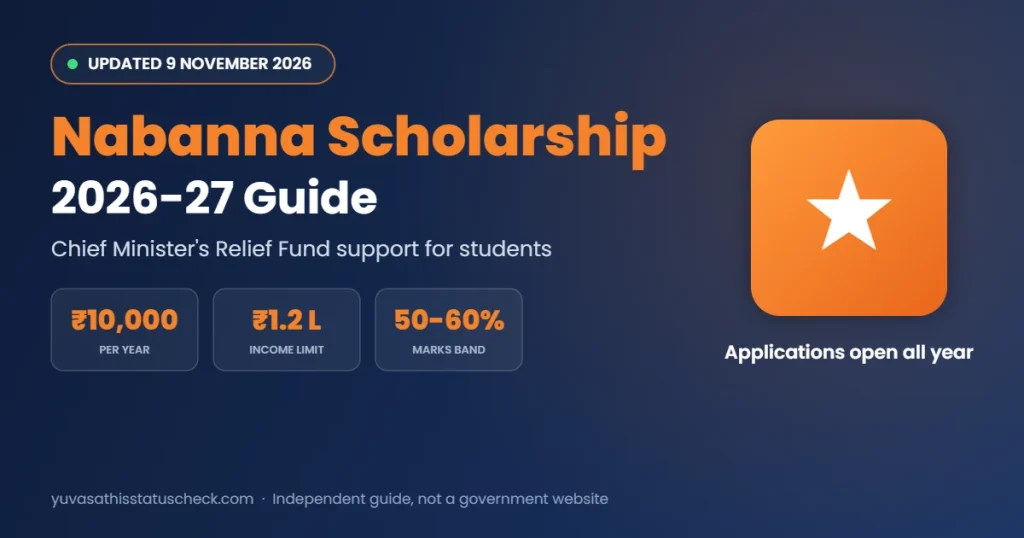
Quick answer: The Nabanna scholarship gives ₹10,000 a year (₹12,000 for professional UG courses such as engineering, pharmacy and medicine) to West Bengal students with a family income up to ₹1.2 lakh a year. HS and UG students need 50% to under 60% in their last board exam; PG students need 50% to under 53% in graduation. Apply on cmrf.wb.gov.in or by post to the Chief Minister’s Office, Nabanna. There is no fixed last date, and you can register only once in 365 days.
Nabanna scholarship at a glance
| Point | Details |
|---|---|
| Paid from | Chief Minister’s Relief Fund (education support) |
| Named after | Nabanna, the state secretariat in Howrah |
| For | HS, UG and PG students in West Bengal |
| Income limit | ₹1,20,000 a year (family) |
| Marks (HS and UG) | 50% to under 60% in the last board exam |
| Marks (PG) | 50% to under 53% in graduation |
| Amount | ₹10,000 a year; ₹12,000 for professional UG courses |
| 2026-27 applications | Open since 16 September 2026 |
| Last date | No fixed date; accepted all year |
| Portal | cmrf.wb.gov.in |
| Helplines | 033-2253 5335, 033-2253 5460 |
What is the Nabanna scholarship?
Many students from poor families score well but fall just short of the 60% needed for the state’s main merit scholarship. The Nabanna scholarship fills that gap. It is paid from the Chief Minister’s Relief Fund and is handled by the Chief Minister’s Office at Nabanna, which is why it is popularly called the Nabanna scholarship. Its official name is often written as the Chief Minister’s Education Relief Fund scholarship.
The money is sent to the student’s bank account and can be used for fees, books, travel and other study needs. Because it is decided case by case by the Chief Minister’s Office, applications are checked carefully, and a complete form with clear documents has the best chance of approval.
Nabanna scholarship 2026-27 update
| Date | Update |
|---|---|
| 16 September 2026 | 2026-27 applications confirmed open on cmrf.wb.gov.in, as reported |
| All year | Applications accepted; no fixed closing date |
| After submission | Processing can take about three months or more |
The scholarship continued after the change of government in 2026, with the Chief Minister’s Office confirming that applications were open for the new session.
Who is eligible for the Nabanna scholarship?
- You must be a permanent resident of West Bengal.
- You must study in a recognised school, college or university in the state.
- Your family income must not be more than ₹1,20,000 a year.
- You must have the marks shown below in your last qualifying exam.
- You must not be getting any other government or private scholarship or stipend for the same stage of study.
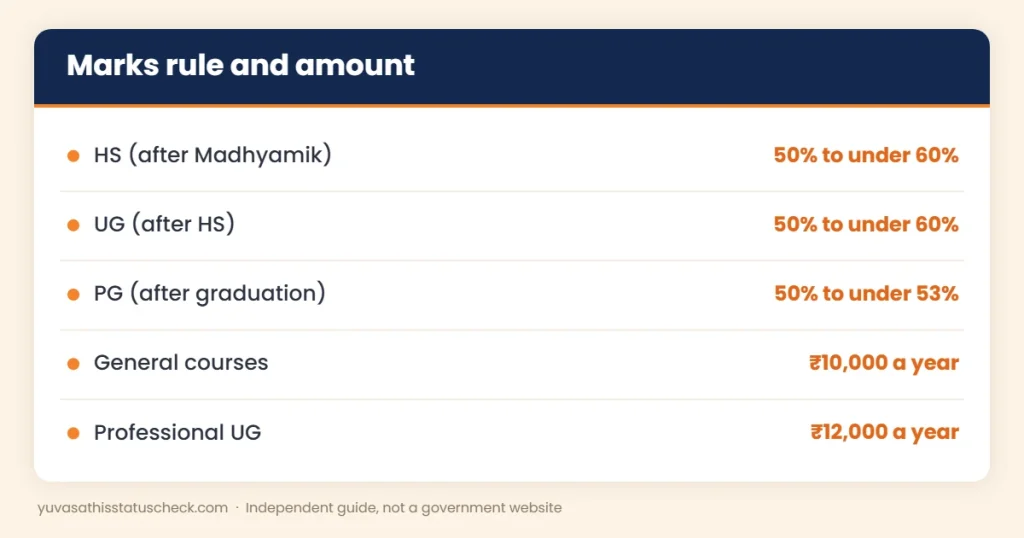
Marks needed for the Nabanna scholarship
| Course you are joining | Exam used for marks | Marks needed |
|---|---|---|
| Higher Secondary (Class 11 and 12) | Madhyamik (Class 10) | 50% to under 60% |
| Undergraduate | Higher Secondary (Class 12) | 50% to under 60% |
| Postgraduate | Graduation | 50% to under 53% |
If you scored 60% or more, you should apply for the SVMCM scholarship instead, which pays more for many courses.
Who should apply: three examples
Example 1: Rina scored 56% in Madhyamik and joined Class 11 in a government school. Her family earns about ₹90,000 a year. She is eligible for the Nabanna scholarship of ₹10,000 a year, since her marks are between 50% and 60% and the income is below ₹1.2 lakh.
Example 2: Arif scored 58% in Higher Secondary and got admission to a B.Tech course. His family income is ₹1.1 lakh. He can apply for the Nabanna scholarship at the professional course rate of ₹12,000 a year.
Example 3: Puja scored 64% in Higher Secondary. She is above the 60% mark, so she should apply for the SVMCM scholarship instead, if her family income is within ₹2.5 lakh.
How to work out your percentage
Use the aggregate percentage printed on your mark sheet. If it is not printed, add the marks of all subjects counted for the aggregate and divide by the total full marks, then multiply by 100. For example, 280 out of 500 is 56%. Use the same method the board uses for the aggregate; do not round up. A score of 59.9% is under 60% and qualifies, but 60% exactly does not fall in the 50% to under 60% band for the Nabanna scholarship.
Nabanna scholarship amount
| Course | Amount per year |
|---|---|
| Higher Secondary | ₹10,000 |
| General undergraduate (Arts, Science, Commerce) | ₹10,000 |
| Professional undergraduate (Engineering, Pharmacy, Medical) | ₹12,000 |
| Postgraduate | ₹10,000 |
The amount is paid once a year after the application is approved.
Nabanna scholarship for students in professional courses
Students who join engineering, pharmacy or medical courses after Higher Secondary with 50% to under 60% marks get the higher rate of ₹12,000 a year. Professional courses cost much more than general degrees, so many of these students also look at low-interest loans and fee waivers offered by their institutions. Keep the admission receipt that clearly shows the course name, as it decides which rate you get. If you change from a general course to a professional one, mention the new course in your next application.
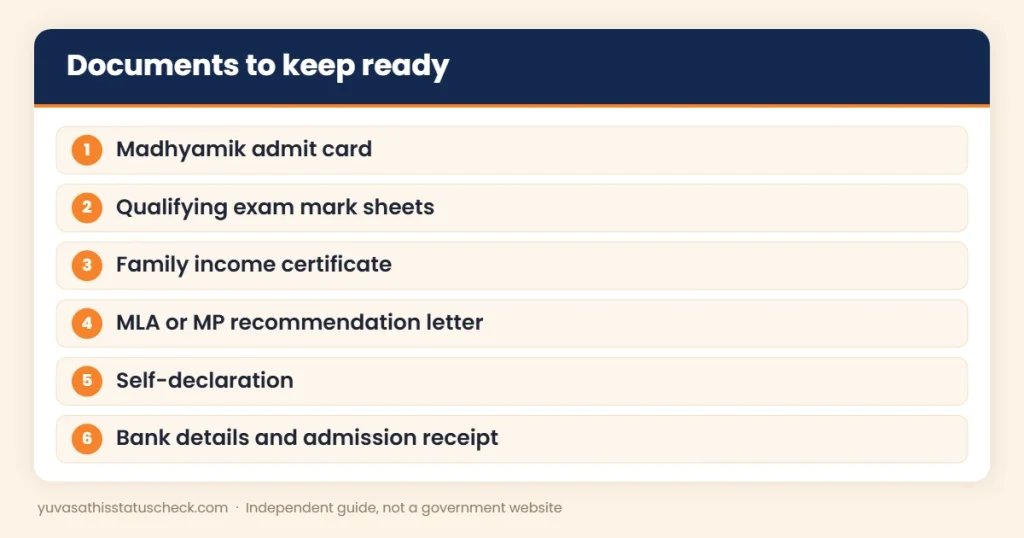
Documents needed for the Nabanna scholarship
- Madhyamik (Class 10) admit card as proof of age.
- Mark sheets of the qualifying exams.
- Family income certificate from an authorised officer.
- Recommendation letter from your local MLA or MP.
- Self-declaration that you meet the rules and do not get any other scholarship.
- Bank account details (account number and IFSC), in the student’s name.
- Admission receipt from your current school, college or university.
- Recent passport-size photo.
If you need an income or residence certificate, read our income certificate guide and residential certificate guide.
Income certificate for this scholarship
The family income limit is low, so the income certificate is checked carefully. Get it from an authorised officer, such as the BDO in rural areas or the SDO or municipal authority in urban areas. The certificate should show the total yearly income of the family from all sources and should be recent. A certificate that is too old or issued by an unauthorised person can lead to rejection.
Writing the self-declaration
The self-declaration is a short signed statement by the student (and a parent, if asked). It usually says that:
- The details given in the form are true.
- The family income is within the limit.
- The student is not getting any other scholarship or stipend for the same stage of study.
- The student will return the money if any information is found to be false.
Write it clearly, sign it, add the date and keep a copy. Some students get the format from their school or college office.
Bank account tips
- Use a savings account in the student’s own name.
- Make sure the account is active and linked with Aadhaar.
- Check the IFSC carefully; a wrong IFSC is a common reason for failed payments.
- Do not use a joint account with someone else as the first holder.
How to get the MLA or MP recommendation letter
The recommendation letter is a special requirement of this scholarship. Here is how students usually get it:
- Find out who the MLA of your assembly constituency or the MP of your Lok Sabha constituency is.
- Visit their local office with your mark sheet, income certificate and admission receipt.
- Request a letter recommending you for financial help for education from the Chief Minister’s Relief Fund.
- Make sure the letter has the MLA’s or MP’s signature, seal, date and your full name.
- Keep the original safe and use a clear scan for the online form.
Do not pay anyone for this letter. MLA and MP offices issue such letters as a public service.
How to apply for the Nabanna scholarship online
- Visit the official portal, cmrf.wb.gov.in.
- Choose the education or scholarship section and register as a new user.
- Fill in your personal, family income, academic and bank details.
- Upload the scanned documents, including the recommendation letter.
- Check every detail and submit the form.
- Save or print the acknowledgement with your application or registration number.
What the money can be used for
The grant is meant for education costs. Students usually use it for:
- Admission and tuition fees.
- Books, guides and stationery.
- Bus or train fares to school or college.
- Exam and form fill-up fees.
- Phone or computer access for online study and forms.
Using the money for study needs also makes it easier to show progress when you apply again next year.
Checklist before you submit
- Your marks are between 50% and under 60% (or 50% to under 53% for PG).
- Your family income certificate shows ₹1.2 lakh or less.
- You have the signed MLA or MP recommendation letter.
- You have your current admission receipt.
- You have written and signed the self-declaration.
- Your bank account is active and in your own name.
- You have not applied in the last 365 days.
How parents can help
Parents play a big part in this application. They usually arrange the income certificate, go with the student to the MLA or MP office and help open or update the bank account. Parents should also keep copies of every document and the acknowledgement in one file, so that the family can follow up with the helpline if needed. If the family’s income changes during the year, keep the latest certificate ready for the next application.
How to apply for the Nabanna scholarship offline
You can also send the filled form and photocopies of all documents by post to:
The Assistant Secretary, Chief Minister’s Office, Nabanna, 325 Sarat Chatterjee Road, Howrah 711102.
Write “Application for educational assistance” on the envelope, send it by registered or speed post, and keep the postal receipt. Do not send original documents. Offline forms can take longer to process than online ones, so use the portal if you have access to a computer or a nearby Bangla Sahayata Kendra.
Nabanna scholarship status check
After you apply, processing can take three months or more. To check progress:
- Log in on the portal with your registration details and look for the application status option.
- Note any remark asking for corrections or extra documents.
- Call the helpline numbers on working days with your application number.
- Check your bank account for the credit once the status shows approval.
Can you apply again next year?
Yes. Students commonly apply each year while they continue to meet the rules, but the portal allows only one registration within 365 days. Plan your application soon after your new admission, so that you can apply again at the same time next year with the new admission receipt.
Tips to get the Nabanna scholarship approved faster
- Apply soon after taking admission, with the new admission receipt.
- Get the MLA or MP letter before you start the online form.
- Upload clear, readable scans of every document.
- Keep the same mobile number for the whole process.
- Call the helpline only after the normal processing time has passed.
What if your application is rejected?
If your application is rejected or returned, read the reason carefully. Common reasons are marks outside the 50% to under 60% band, income above the limit, a missing recommendation letter or another scholarship already being received. If the problem can be fixed, such as a missing document, ask the helpline whether you can submit it. Remember that you can register only once in 365 days, so check everything before submitting a new Nabanna scholarship application next year.
Beware of fake websites and agents
Use only cmrf.wb.gov.in for online applications. Do not pay any agent who promises to get the scholarship sanctioned. The government does not charge any fee for this application, and the recommendation letter from your MLA or MP is also free.
Common problems and fixes
| Problem | What to do |
|---|---|
| Marks above 60% | Apply for SVMCM instead; this scholarship is for 50% to under 60% |
| No MLA or MP letter | Visit the representative’s office early; the form is incomplete without it |
| Income above ₹1.2 lakh | Not eligible; check other scholarships |
| Status not updating | Wait three months, then call the helpline with your application number |
| Already getting another scholarship | Not eligible for the same stage of study |
| Registration blocked | Only one registration is allowed in 365 days |
For help linking Aadhaar with your bank account, read our DBT link guide.
Nabanna scholarship vs other West Bengal scholarships
| Scholarship | Marks rule | Income limit |
|---|---|---|
| Nabanna scholarship | 50% to under 60% (PG: 50% to under 53%) | ₹1.2 lakh |
| SVMCM | 60% and above (PG: 53% or 55%) | ₹2.5 lakh |
| Aikyashree | 50% and above for minority students | ₹2 lakh to ₹2.5 lakh |
| Oasis | As per scheme, for SC, ST and OBC students | Varies by scheme |
Minority students can check the Aikyashree scholarship, and SC, ST and OBC students the Oasis scholarship. If you need a larger amount for a costly course, the Student Credit Card offers a low-interest education loan.
Frequently asked questions
What is the Nabanna scholarship?
It is a scholarship from the Chief Minister’s Relief Fund for West Bengal students from poor families who scored 50% to under 60% in their last board exam.
How much does the Nabanna scholarship give?
₹10,000 a year, or ₹12,000 a year for professional undergraduate courses such as engineering, pharmacy and medicine.
What is the income limit?
Family income should not be more than ₹1,20,000 a year.
Is there a last date for 2026-27?
No fixed last date. Applications are accepted throughout the year, but apply early as processing takes time.
Is the MLA or MP letter compulsory?
Yes, a recommendation letter from the local MLA or MP is listed among the required documents.
Can I get both Nabanna and SVMCM?
No. Nabanna is for students who do not get another scholarship for the same stage, and SVMCM needs 60% or more.
Can I apply for the Nabanna scholarship if I scored exactly 60%?
No. The band is 50% to under 60% for HS and UG. Students with 60% or more should apply for SVMCM.
How long does the Nabanna scholarship take to arrive?
Processing can take about three months or more after you apply.
Where do I send the offline form?
To the Assistant Secretary, Chief Minister’s Office, Nabanna, 325 Sarat Chatterjee Road, Howrah 711102.
What are the Nabanna scholarship helpline numbers?
033-2253 5335 and 033-2253 5460. The listed email is [email protected].
Sources we checked
- FindMyCollege, 16 September 2026: 2026-27 opening, eligibility, amount, documents, address and helplines.
- Buddy4Study: West Bengal Chief Minister Scholarship 2026-27: overview of the scheme.
- IndiaScholarships: Nabanna scholarship: application steps.
Disclaimer: yuvasathisstatuscheck.com is an independent information website. It is not connected with the Chief Minister’s Office or the Government of West Bengal. Always confirm details on the official portal or helpline.