Bhorsha Karmasuchi 2026: What West Bengal’s Budget Promised Unemployed Youth (₹3,000 & ₹2,000 Explained)
Last checked: 29 October 2026. Bhorsha Karmasuchi is the name that appears in West Bengal’s 2026-27 budget for the new monthly allowance for unemployed youth. Most people know the same plan as Yuva Shakti or the Yuva Shakti Bharosa Card.
Because of the different names, many young people are unsure whether Bhorsha Karmasuchi is a separate scheme. It is not. This guide explains what Bhorsha Karmasuchi means, what the budget promised, who may qualify, where the launch stands and how you can prepare today.
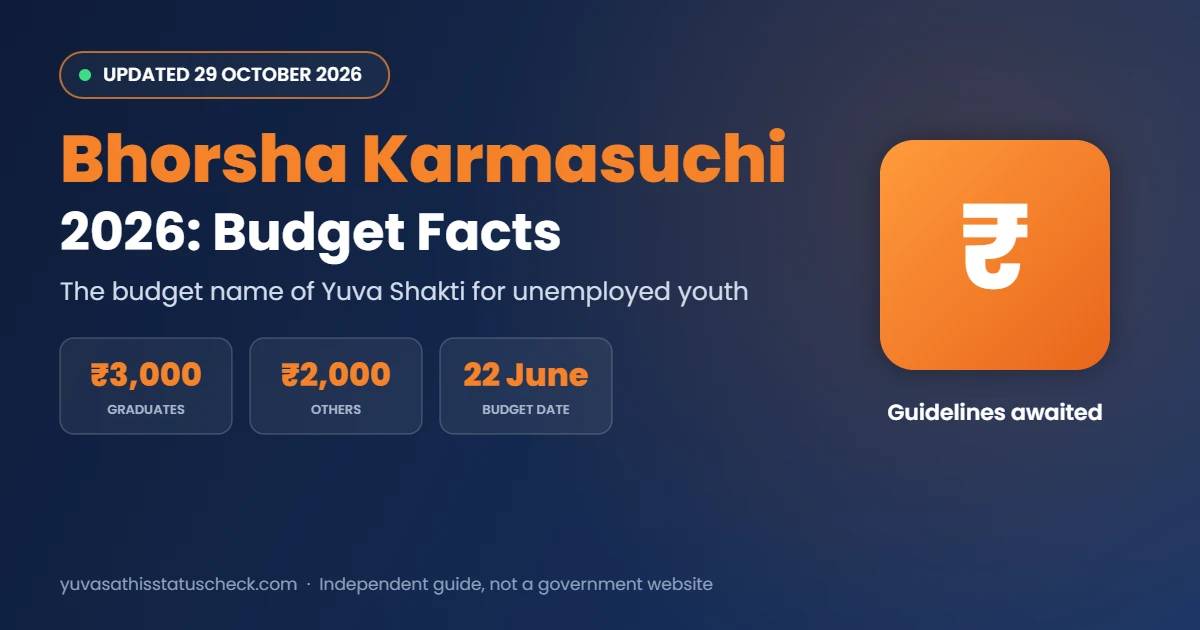
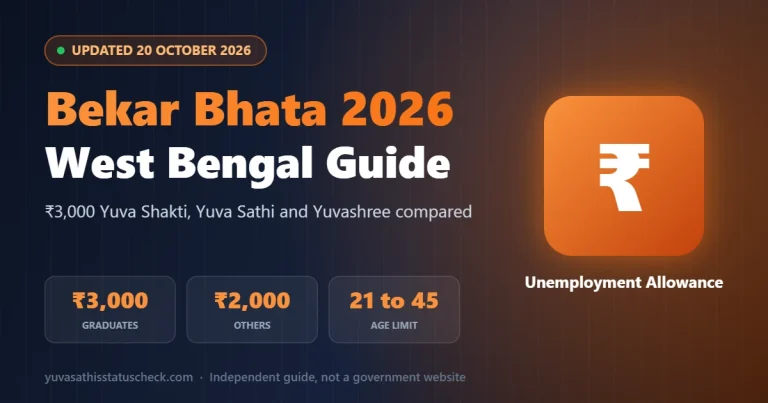
Quick answer: Bhorsha Karmasuchi is the budget name of the Yuva Shakti scheme. It proposes ₹3,000 a month for unemployed graduates and ₹2,000 a month for other eligible educated youth. As of 29 October 2026, the guidelines, portal and application form have not been released.
What is Bhorsha Karmasuchi?
Bhorsha Karmasuchi is a West Bengal government programme to give monthly financial support to educated young people who do not have a job. It was announced in the state budget for 2026-27, presented on 22 June 2026.
The name comes from two Bengali words. “Bhorsha” (ভরসা) means trust or assurance, and “Karmasuchi” (কর্মসূচি) means programme. So Bhorsha Karmasuchi roughly means “assurance programme”. It is the budget form of the “Yuva Shakti Bharosa Card” that was promised during the 2026 Assembly election campaign.
In short, if you read about Yuva Shakti, Yuva Shakti Bharosa Card or Bhorsha Karmasuchi, you are reading about the same plan. Our main Yuva Shakti scheme guide covers it under its popular name.
Why the budget name matters
When the official guidelines, government orders and the application portal are published, they may use the budget name rather than the election name. If you search only for “Yuva Shakti”, you might miss an order titled with the other name. So it is worth knowing both. When you see a notice from the Youth Services and Sports Department or from Nabanna about an allowance of ₹3,000 and ₹2,000 for unemployed youth, it is almost certainly about this programme, whatever name it carries.
Bhorsha Karmasuchi at a glance
| Point | Details (as reported on 29 October 2026) |
|---|---|
| Official budget name | Bhorsha Karmasuchi |
| Popular name | Yuva Shakti / Yuva Shakti Bharosa Card |
| Announced in | West Bengal Budget 2026-27, 22 June 2026 |
| Department (reported) | Youth Services and Sports Department |
| Amount for graduates | ₹3,000 a month (₹36,000 a year) |
| Amount for others | ₹2,000 a month (₹24,000 a year) |
| Age limit (reported) | 21 to 45 years |
| Family income limit (reported) | Below ₹1 lakh a year |
| Payment mode | Direct Benefit Transfer (DBT) |
| Guidelines | Not released yet |
| Application form | Not open yet |
Bhorsha Karmasuchi and Yuva Shakti: same scheme, different names
Here are all the names you may see, and where each one comes from:
| Name | Where it is used |
|---|---|
| Yuva Shakti Bharosa Card | BJP’s election promise in 2026 |
| Bhorsha Karmasuchi | State budget 2026-27 |
| Bharosa Karmasuchi or Bhorosha Karmasuchi | Different English spellings in news reports |
| Yuva Shakti / Banglar Yuva Shakti | Popular name used by people and the media |
| ভরসা কর্মসূচি | Bengali name |
Once the government issues the notification, the official name on the portal and form will settle the question. Until then, treat Bhorsha Karmasuchi and Yuva Shakti as one and the same.
What the budget announced
The budget for 2026-27 was the first full budget of the new government led by Chief Minister Suvendu Adhikari. According to reports on the budget, Bhorsha Karmasuchi was announced with these main points:
- ₹3,000 a month for unemployed youth who are graduates.
- ₹2,000 a month for other eligible educated unemployed youth.
- Age limit of 21 to 45 years.
- Annual family income below ₹1 lakh.
- Not for people already getting a similar social protection benefit.
- Implementation planned from October 2026.
News reports also quoted the Finance Minister, Swapan Dasgupta, as saying that applications would begin in October. That has not happened yet, as you will see in the timeline below.
How much will Bhorsha Karmasuchi pay in a year?
| Applicant | Monthly | Yearly |
|---|---|---|
| Unemployed graduate | ₹3,000 | ₹36,000 |
| Other educated unemployed youth | ₹2,000 | ₹24,000 |
| Old Yuva Sathi (for comparison) | ₹1,500 | ₹18,000 |
For a full side-by-side view with the old scheme, read our Yuva Shakti vs Yuva Sathi comparison.
Who can get Bhorsha Karmasuchi?
The final eligibility rules will be in the official guidelines. Based on budget reports, Bhorsha Karmasuchi is expected to cover people who meet all of these conditions:
- Permanent resident of West Bengal.
- Aged 21 to 45 years. A few news reports still mention 21 to 40, so check the final notice. Our Yuva Shakti age limit guide has date-of-birth examples.
- Educated: at least Madhyamik pass. Graduates get the higher level.
- Unemployed: no regular job or steady business income.
- Family income below ₹1 lakh a year.
- Not receiving another similar social protection allowance.
For a rule-by-rule check, see our Yuva Shakti eligibility guide.
What does “educated unemployed” mean?
Budget reports use the phrase “educated unemployed youth”. In practice, it is expected to mean young people who have passed at least Madhyamik and do not have a regular salaried job. The exact definition, including whether students or part-time workers can apply, will be in the final guidelines.
What can the money be used for?
Bhorsha Karmasuchi is meant to support young people while they look for work. Reports describe uses such as:
- Fees for competitive exams and job applications.
- Coaching, books and study material.
- Skill training and short courses.
- Travel for interviews and exam centres.
- Basic daily costs during the job search.
There is no rule that you must spend the money on a fixed list. But the purpose is clear: the scheme is support for job seekers, not a permanent pension.
Bhorsha Karmasuchi launch status: timeline so far
Here is how the timeline has moved since the election:
| Date | What happened |
|---|---|
| April–May 2026 | Yuva Shakti Bharosa Card promised in the election campaign |
| May 2026 | New government takes office |
| 22 June 2026 | Bhorsha Karmasuchi announced in Budget 2026-27 |
| September 2026 | Reports said the application process would start soon |
| 1 October 2026 | No guidelines published; October payments looked unlikely |
| 17 October 2026 | Reports suggested registration may start in November |
| 28 October 2026 | Still no official notice; portal not launched |
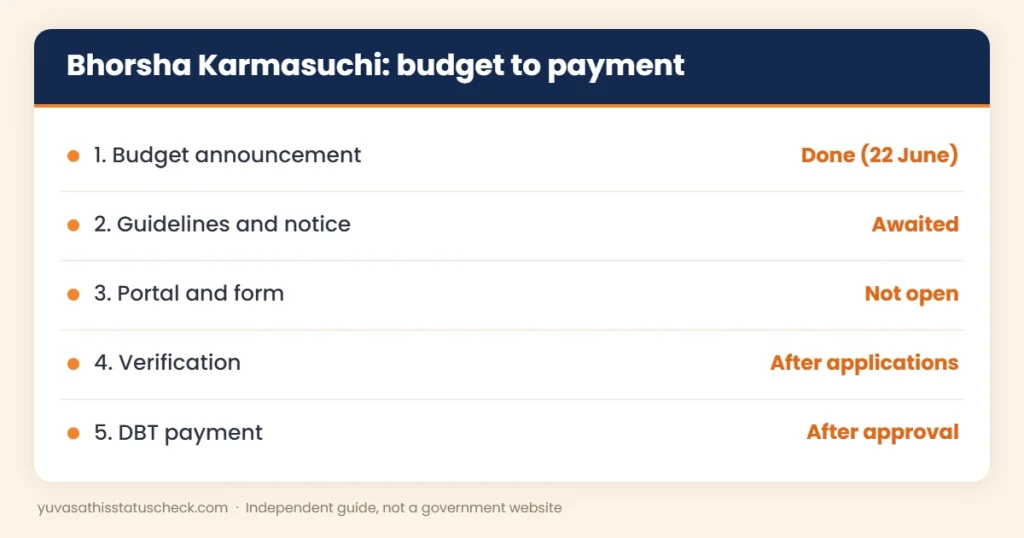
As of 29 October 2026, there is no official Bhorsha Karmasuchi notification, portal link or form. Our Yuva Shakti apply date tracker will be updated the day an official date is announced. If you see a date shared on social media, compare it with the timeline above. Any date that is not backed by an official notice is only a guess, so do not rush to cyber cafes or agents because of a forwarded message.
Why is Bhorsha Karmasuchi delayed?
No official reason has been given. Based on news reports, these factors seem to be slowing the launch:
- Guidelines not finalised. Rules on income, education, age and other allowances need a formal order.
- Durga Puja holidays. Reports said the portal could not be launched in October because of the festive break.
- Verification of old data. In June 2026, reports said the government wanted to verify the papers of roughly 55 lakh people on the old Yuva Sathi list.
- Portal preparation. A new form with two payment levels and an income check needs fresh software.
None of this means the scheme has been dropped. It only means the timeline has slipped.
How the Bhorsha Karmasuchi application is likely to work
The application process has not been published. Based on how the earlier Yuva Sathi form worked, applications will most likely follow these steps:
- Open the official portal ending in .wb.gov.in.
- Register with your mobile number and an OTP.
- Fill in personal, address, education, income and employment details.
- Enter your Aadhaar and voter card numbers.
- Add bank details for DBT.
- Upload documents, a photo and your signature.
- Submit and keep the application number safe.
Offline help may also be offered at government camps. For a field-by-field walkthrough, read our Yuva Shakti form fill up guide, and bookmark the Yuva Shakti online apply page for the link.
Documents to keep ready for Bhorsha Karmasuchi
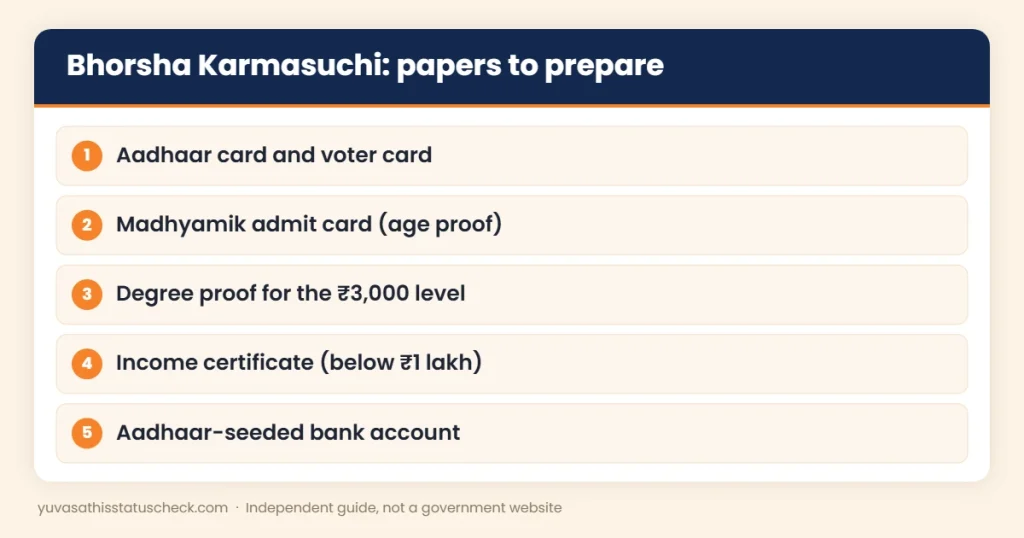
No official document list has been released yet. These are the papers most likely to be asked for:
- Aadhaar card
- Voter card (EPIC)
- Madhyamik admit card, as proof of age
- Madhyamik marksheet or certificate
- Graduation marksheet or certificate, for the ₹3,000 level
- Income certificate, because of the ₹1 lakh income limit
- Bank passbook first page, for an Aadhaar-seeded account
- Caste certificate, if you belong to SC, ST or OBC
- Self-declaration of unemployment and residence
- Passport-size photo and signature
See our Yuva Shakti documents required list for scan size tips. If you need an income certificate, our income certificate West Bengal guide shows how to apply on e-District.
Bhorsha Karmasuchi compared with older allowances
West Bengal has had more than one allowance for unemployed youth. Here is how Bhorsha Karmasuchi fits in.
| Scheme | Monthly amount | Status |
|---|---|---|
| Yuvashree | ₹1,500 | Older scheme linked to the Employment Bank |
| Banglar Yuva Sathi | ₹1,500 | Applications closed; payments on hold |
| Bhorsha Karmasuchi (Yuva Shakti) | ₹3,000 / ₹2,000 | Announced; launch awaited |
Read more about the oldest of these in our Yuvashree Prakalpa guide, or see all three side by side in our bekar bhata comparison.
A closer look at the ₹1 lakh income rule
The reported income limit is the biggest new rule, and it may decide who qualifies. Here is what it is likely to mean in practice.
Family income, not personal income. The limit is reported as annual family income. That usually means the total yearly income of the people in your household, such as parents, spouse and earning siblings, from all sources.
About ₹8,300 a month. An income below ₹1 lakh a year works out to roughly ₹8,333 a month for the whole family. Many daily-wage, small-farmer and informal-work families fall in this range.
Proof will matter. The form is likely to ask for an income certificate issued by the BDO or SDO, or at least a declaration that can be checked. A certificate that is old or shows a higher figure could lead to rejection.
Be honest. If your family income is above the limit, do not hide it. Wrong declarations can lead to rejection, and in some schemes the money is recovered later.
If you do not have a recent certificate, apply now so it is ready when the form opens.
Graduate or not: which level will you get?
The amount depends on your highest education. This simple table shows the expected level and the proof you should keep.
| Your education | Expected level | Proof to keep |
|---|---|---|
| Madhyamik pass | ₹2,000 a month | Madhyamik admit card and marksheet |
| Higher Secondary pass | ₹2,000 a month | HS marksheet |
| Diploma or ITI | Not yet clear | Diploma certificate |
| Graduate (BA, BSc, BCom or equal) | ₹3,000 a month | Final marksheet or degree certificate |
| Postgraduate | ₹3,000 a month (expected) | PG and UG marksheets |
If your degree certificate has not been issued yet, ask your college for a provisional certificate. Also check that your name is spelt the same way on your degree and your Aadhaar card, because a mismatch can hold up verification.
What happens to old Yuva Sathi applicants?
Many people applied for Yuva Sathi in February 2026 and want to know if they will move to the new plan automatically. There is no official order on this yet.
A report in May 2026 said all beneficiaries, old and new, would have to apply afresh under the new system. Reports in June said the government would first verify the old list. So the safest plan is to prepare for a new application. Keep your old application number and bank details, but do not assume they will be carried over.
You can still look up your old record through our Yuva Sathi status check guide.
How the DBT payment is expected to work
Once applications are approved, money is expected to go to bank accounts by Direct Benefit Transfer. DBT payments usually depend on three things:
- An account in your own name. Joint accounts where you are not the first holder can cause problems.
- Aadhaar seeding. Your Aadhaar must be linked to the account through the bank, so the payment system knows where to send the money.
- An active account. Dormant accounts, accounts without KYC or closed accounts will bounce the payment.
You will usually get an SMS from your bank when the money arrives. If a payment fails, the department normally asks the applicant to fix the bank details through the portal or a local office.
Tips for a smooth application when the form opens
- Apply early instead of waiting for the last few days, when the portal is often slow.
- Use your own mobile number, linked to Aadhaar, for OTPs.
- Keep every scan under the size limit and make sure it is readable.
- Fill in your name exactly as it appears on Aadhaar.
- Save or print the acknowledgement as soon as you submit.
- Check your application status a few days later.
How to stay safe from Bhorsha Karmasuchi scams
New schemes attract fake websites and agents. Protect yourself with these simple rules:
- Apply only on an official website ending in .gov.in.
- Never pay anyone to “register” you for this scheme. Government forms are free.
- Never share your OTP, ATM PIN or bank password.
- Do not trust a “beneficiary list” shared on WhatsApp before applications have even opened.
- Report online fraud at cybercrime.gov.in.
What to do now
While you wait for the official notification, use the time well:
- Match your name and date of birth across Aadhaar, voter card, school papers and bank records.
- Link Aadhaar with your bank account for DBT and check the seeding status on the myAadhaar portal.
- Apply for a fresh income certificate.
- Keep degree proof ready if you are a graduate.
- Scan every document as a clear PDF.
- Watch for official news from the state government.
For payment timing once the form opens, follow our Yuva Shakti payment date page.
Frequently asked questions
What is Bhorsha Karmasuchi?
It is the name used in West Bengal’s 2026-27 budget for the new monthly allowance for unemployed youth, popularly called Yuva Shakti.
Is Bhorsha Karmasuchi the same as Yuva Shakti?
Yes. Yuva Shakti Bharosa Card was the election promise, and Bhorsha Karmasuchi is the budget name of the same plan.
How much money does Bhorsha Karmasuchi give?
Budget reports say ₹3,000 a month for unemployed graduates and ₹2,000 a month for other eligible educated unemployed youth.
What is the age limit for Bhorsha Karmasuchi?
Budget reports say 21 to 45 years. Some news reports still mention 21 to 40, so wait for the official notice.
Is there an income limit?
Reports say the annual family income should be below ₹1 lakh.
When will the Bhorsha Karmasuchi form open?
No official date has been announced. As of 29 October 2026, reports suggest the form may open in November 2026.
Can Yuva Sathi beneficiaries get Bhorsha Karmasuchi?
There is no official order yet. Reports suggest a fresh application may be needed, and the new income rule will also apply.
Is there any fee to apply?
No. Government applications for such schemes are free. Do not pay agents.
Sources we checked
- GovtSchemes.in: West Bengal Bhorsha Karmasuchi: budget date, amounts, age and income rules.
- GovtSchemesIndia: Bhorsha Karmasuchi: amounts, eligibility and October target.
- India Hood Bangla, 28 October 2026: no official update yet; minister’s October statement.
- EduTips, 1 October 2026: no guidelines as of 1 October.
Disclaimer: yuvasathisstatuscheck.com is an independent information website. It is not connected with the Government of West Bengal. Always confirm details in the official notification before applying.
5 Comments