Kanyashree Prakalpa 2026 (Now Kanyaratna): K1 to Double to ₹2,000, K2 Update, Eligibility & Status Check
Last checked: 3 November 2026. Kanyashree Prakalpa is one of West Bengal’s best-known schemes for girls. It pays an annual scholarship to schoolgirls and a one-time grant at 18 to keep girls in education and stop early marriage. In 2026, the scheme has a new name in government events, Kanyaratna, and a big announced change: the yearly K1 amount is set to double.
This guide puts everything in one place for students and parents. It explains what Kanyashree Prakalpa is, what changed in 2026, who can apply, how much money K1 and K2 give, how to apply through your school, how to check status and what the new ₹50,000 grant for college girls means.
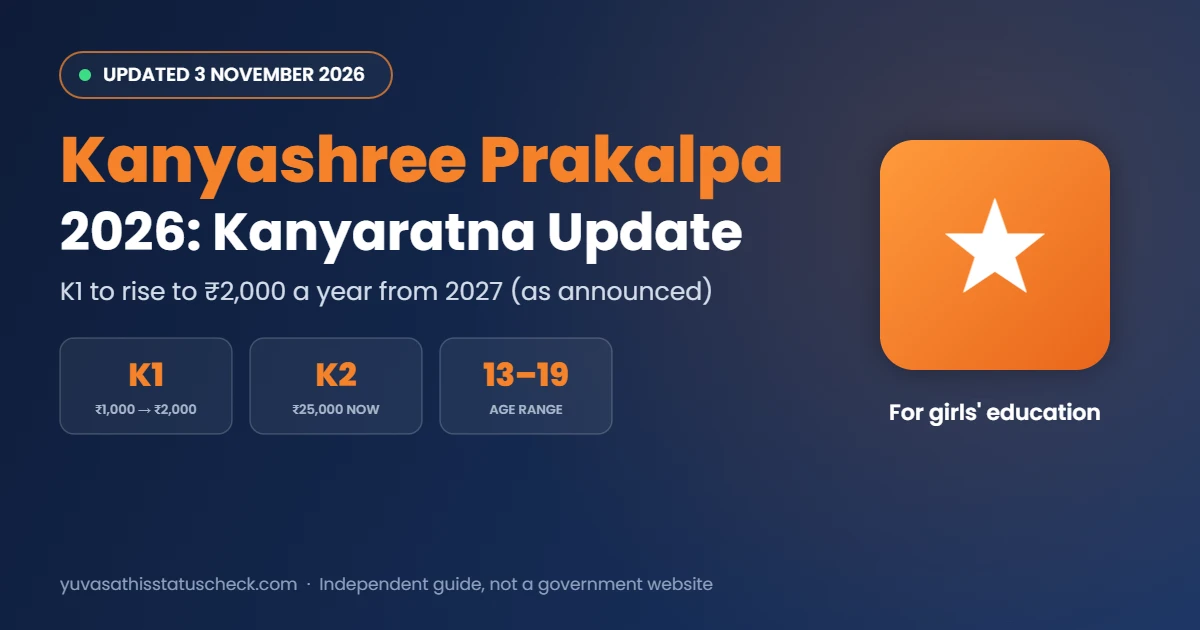
Quick answer: Kanyashree Prakalpa continues in 2026. On 14 August 2026, Chief Minister Suvendu Adhikari announced at a Kanyaratna Day event that the K1 scholarship will rise from ₹1,000 to ₹2,000 a year from the 2027 academic year. K2 (₹25,000 one-time) continues. A separate ₹50,000 grant for unmarried girls joining college was announced in the 2026-27 budget.
Also read: SVMCM scholarship 2026-27 and Bhagini Nivedita Scheme.
What is Kanyashree Prakalpa?
Kanyashree Prakalpa is a conditional cash transfer scheme of the Government of West Bengal for girls. It was launched on 1 October 2013 and is run by the Department of Women and Child Development and Social Welfare.
The idea is simple: if a girl stays in education and stays unmarried until 18, the state gives her money directly in her own bank account. This encourages families to keep girls in school and delays child marriage. The scheme won the United Nations Public Service Award in 2017.
Kanyashree Prakalpa at a glance
| Point | Details |
|---|---|
| Launched | 1 October 2013 |
| Department | Women and Child Development and Social Welfare |
| K1 | Annual scholarship of ₹1,000 (to rise to ₹2,000 from 2027, as announced) |
| K2 | One-time grant of ₹25,000 |
| Age | 13 to 18 for K1; 18 to 19 for K2 |
| Main conditions | Unmarried and enrolled in education or training |
| Income limit | No income limit (removed in 2018-19) |
| How to apply | Through the girl’s school, college or institution |
| Payment | Directly to the girl’s bank account |
Why Kanyashree Prakalpa matters
Before the scheme, many girls left school early, and child marriage was common in some districts. By paying money only to girls who stay in education and remain unmarried, Kanyashree Prakalpa gives families a direct reason to keep daughters in school. The money goes to the girl’s own account, which also helps girls learn to use a bank. Over the years, the scheme has reached lakhs of girls in every district of the state, and it has been studied as a model by other states and international bodies.
What changed in 2026: Kanyashree becomes Kanyaratna
After the new government took office in May 2026, there were questions about whether Kanyashree Prakalpa would continue. In August, the answer came.
On 14 August 2026, at a state event at Dhanadhanya Auditorium in Kolkata, the Chief Minister announced that girls who now get ₹1,000 a year under the scheme will get ₹2,000 instead. Reports said this increase applies from the 2027 academic year. The event was held as Kanyaratna Day, and reports describe Kanyaratna as the new name for Kanyashree Prakalpa rather than a separate scheme.
Some reports also said the state formally adopted the central Beti Bachao Beti Padhao campaign on the same day. Ministers Agnimitra Paul and Malati Rava Roy were also reported to be present at the event.
What this means for you
- If you already get K1: you continue under the scheme. The higher amount is expected from the 2027 academic year.
- For the 2026-27 year: the existing amounts are expected to apply.
- Your forms and process: these stay with your school or college until the department issues new instructions.
We have not seen a published government order for the new amounts yet, so treat the dates as announced, not final.
Kanyashree Prakalpa K1, K2 and K3 explained
The scheme has different parts for different ages.
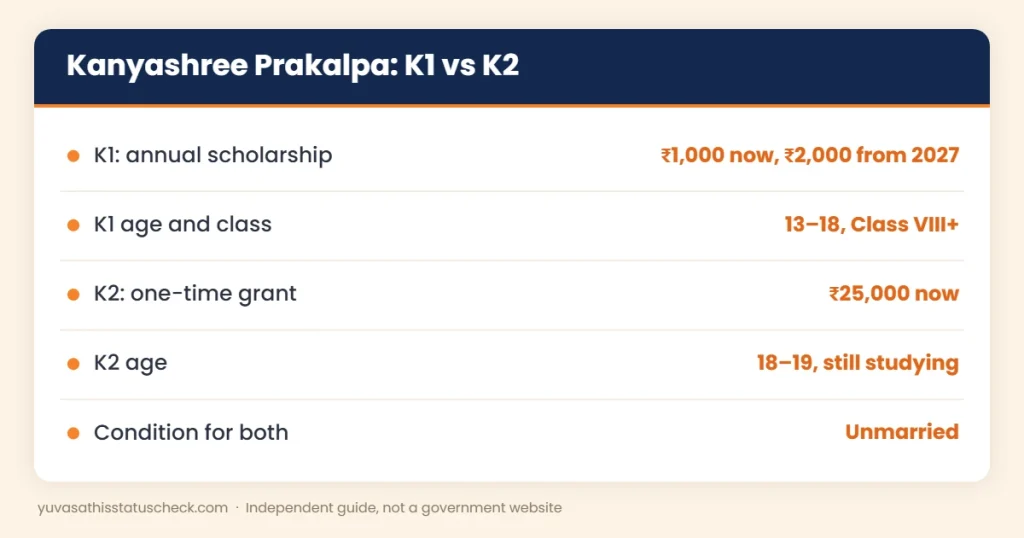
K1: annual scholarship
- For unmarried girls aged 13 to 18.
- Must be studying in Class VIII or above (girls with 40 percent or more disability are exempt from the class rule).
- Amount: ₹1,000 a year now; announced to rise to ₹2,000 a year from 2027.
K2: one-time grant
- For girls aged 18 to 19 who are unmarried.
- Must be enrolled in education, or in vocational, technical or sports training.
- Amount: ₹25,000 one-time.
K3: postgraduate support
- An extension for Kanyashree girls who go on to postgraduate studies, handled through higher education channels. Check with your university for the current rules and amounts.
| Part | Age | Condition | Amount |
|---|---|---|---|
| K1 | 13–18 | Unmarried, Class VIII or above | ₹1,000 a year (₹2,000 from 2027, as announced) |
| K2 | 18–19 | Unmarried, in education or training | ₹25,000 one-time |
| K3 | PG level | Kanyashree beneficiary in PG course | As notified |
Will K2 also become ₹50,000?
Some websites say K2 will rise from ₹25,000 to ₹50,000. We have not found this in official statements. What the 2026-27 budget did announce is a separate one-time ₹50,000 grant for unmarried girls joining undergraduate courses in government and government-aided colleges. Do not confuse the two until the department publishes clear rules.
Who can apply for Kanyashree Prakalpa?
A girl can apply if she:
- Is a permanent resident of West Bengal.
- Is unmarried at the time of applying.
- Is aged 13 to 18 for K1, or 18 to 19 for K2.
- Is studying in Class VIII or above for K1, or is enrolled in education or training for K2.
- Has a bank account in her own name.
There is no family income limit. The earlier income ceiling was removed in 2018-19, so girls from all income groups can apply.
Special cases
Girls with disabilities: girls with 40 percent or more disability can get K1 even if they are not yet in Class VIII. Keep the disability certificate ready with the form.
Madrasah students: girls studying in recognised madrasahs apply through their madrasah, in the same way as school students.
Vocational and sports training: for K2, girls enrolled in recognised vocational, technical or sports training also qualify, not only those in regular college courses.
Girls who left school: a girl who has dropped out cannot get K1. If she rejoins education, she can apply again through her new institution.
What happens if a girl marries before 18?
The whole idea of Kanyashree Prakalpa is to delay marriage until at least 18. A girl who marries before 18 is not eligible for K1 or K2. If a family gives false information, such as claiming a married girl is unmarried, the payment can be stopped and recovered. Child marriage is also illegal, so schools and local officials are encouraged to report it.
How to apply for Kanyashree Prakalpa
Applications are made through the institution where the girl studies. The steps are:
- Get the form. Collect the K1 or K2 form from the school, madrasah, college or training institution.
- Fill in the details. Write the girl’s name, date of birth, parents’ names, address, class and bank details.
- Attach documents. Add age proof, bank details and any declaration the institution asks for.
- Submit at the institution. The school or college checks the form and uploads it on the Kanyashree portal.
- Verification. The block or municipality office verifies the application.
- Payment. After approval, the money is sent to the girl’s bank account.
Each institution usually has a teacher who looks after Kanyashree Prakalpa forms. Ask at the school office for that teacher. It is a good idea to submit the form early in the academic year, because institutions upload forms in batches and late forms may miss the cycle.
K1 renewal every year
K1 is an annual scholarship, so it has to be renewed each year while the girl is eligible. The institution usually collects renewal details at the start of the academic year. If the girl changes school, she should tell the new school that she is a Kanyashree Prakalpa beneficiary, so the record moves with her. Missing a renewal can mean missing that year’s payment.
Bank account tips for girls
- Open a savings account in the girl’s own name; many banks offer zero-balance accounts for students.
- Link the girl’s Aadhaar to the account for DBT.
- Use a parent’s mobile number for SMS alerts if the girl has no phone.
- Do one small transaction every few months so the account stays active.
- Keep the passbook updated and safe.
Documents needed for Kanyashree Prakalpa
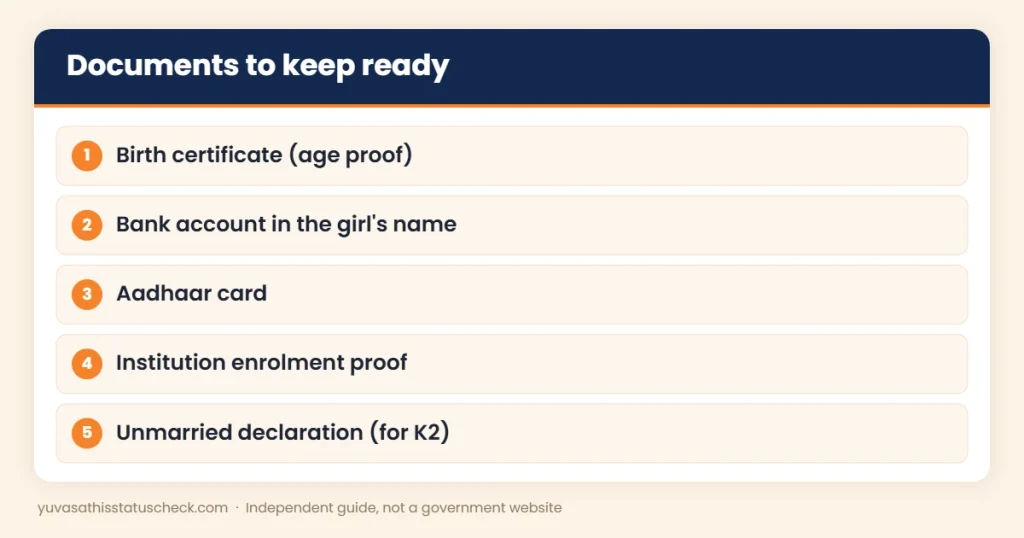
- Birth certificate or other age proof.
- Bank account in the girl’s own name (passbook first page).
- Aadhaar card, where asked.
- Proof of enrolment, such as a school ID or admission receipt.
- Declaration that the girl is unmarried (for K2).
- Recent passport-size photograph.
- Disability certificate, if applying under the disability relaxation.
If your bank account is not seeded with Aadhaar, the payment can fail. Our DBT link guide explains how to check this on myAadhaar.
How to check Kanyashree Prakalpa status
You can track an application in two ways:
- Online: open the official Kanyashree portal, use the option to track your application and enter the application ID given by your institution.
- Through your institution: ask the Kanyashree teacher at your school or college to check the status for you.
If the status shows a problem, such as a bank error, ask the institution how to correct it. Most corrections are done by the institution, not by the student directly.
Common status problems
| Problem | Likely reason | Fix |
|---|---|---|
| Payment failed | Wrong account number, IFSC or inactive account | Give a fresh passbook copy to the institution |
| Not sanctioned | Missing document or age mismatch | Correct and resubmit through the institution |
| Pending for months | Verification delay | Ask the institution to follow up with the block office |
| K2 rejected | Marriage before 18 or not in education | Check the rules; ask the institution for the reason |
Kanyashree Prakalpa helpline and offices
For help, start with your own institution, because it handles forms, uploads and corrections. If the problem is not solved there, the block office (rural areas) or the municipality office (towns) can check the verification stage. The district office of the Women and Child Development and Social Welfare Department is the next level. Official notices are posted on the department’s website, wcdsw.wb.gov.in, and on the Kanyashree portal.
Kanyashree Prakalpa and the new ₹50,000 college grant
The 2026-27 state budget, presented on 22 June 2026, announced a one-time grant of ₹50,000 for unmarried girls enrolling in undergraduate courses in government and government-aided colleges. A budget allocation of ₹1,000 crore was reported for it.
In October 2026, a report said the state cabinet approved this support as the Bhagini Nivedita scheme, with ₹50,000 paid over three years and the first instalment expected from January 2027. This is separate from Kanyashree Prakalpa. A girl who gets K2 at 18 may later also benefit from the college grant, depending on the final rules.
How Kanyashree Prakalpa fits with other schemes
| Scheme | For whom | Status (as reported) |
|---|---|---|
| Kanyashree / Kanyaratna | Girls aged 13–19 in education | Running; K1 to rise from 2027 |
| ₹50,000 college grant | Unmarried girls joining UG in govt/aided colleges | Announced; first instalment expected 2027 |
| Taruner Swapna (₹10,000 tab) | Class 11 students | Reported as discontinued |
| Yuva Shakti (₹3,000 / ₹2,000) | Unemployed youth aged 21+ | Form not open yet |
For the tablet scheme, read our Taruner Swapna update. Girls who finish their studies and are looking for work should also follow our Yuva Shakti scheme guide.
3 real-life examples
Riya, 14, Class IX, Bankura: Riya applied for K1 through her school’s Kanyashree teacher with her birth certificate and bank passbook. She gets the annual scholarship in her own account and expects the higher amount from 2027 under Kanyashree Prakalpa.
Sahana, 18, first-year BA, Murshidabad: Sahana applied for K2 through her college as an unmarried student. She received ₹25,000. Because she joined a government college, she will also watch for the new college grant.
Mou, 15, Class VIII, Kolkata: Mou’s first payment failed because her account was not seeded with Aadhaar. Her school updated the bank details after she fixed the seeding at her bank, and the next payment went through.
Mistakes to avoid
- Using a bank account in a parent’s name instead of the girl’s own name.
- Writing a date of birth that does not match the birth certificate.
- Missing the institution’s submission deadline.
- Letting the bank account become dormant.
- Paying agents to “fast-track” a Kanyashree Prakalpa form.
- Ignoring messages from the school about corrections.
Kanyashree Prakalpa in 2027: what to expect
If the announced change is implemented, K1 beneficiaries will get ₹2,000 a year from the 2027 academic year. Watch for:
- A government order with the new amount and start date.
- New forms or portal changes under the Kanyaratna name.
- Rules for the separate college grant for girls.
- Any changes to K2.
Until then, keep applying and renewing through your institution as usual.
Tips for parents and students
- Open a bank account in the girl’s own name early and keep it active.
- Make sure the name and date of birth match on the birth certificate, school records and bank account.
- Submit forms on time; institutions have their own deadlines.
- Keep copies of every form and receipt.
- Never pay anyone to “approve” a Kanyashree Prakalpa form.
Documents for later schemes
Girls who move on to college or jobs will need more certificates. Get them early:
Frequently asked questions
Is Kanyashree Prakalpa still running in 2026?
Yes. The scheme continues, and in August 2026 the Chief Minister announced a higher K1 amount from the 2027 academic year.
What is Kanyaratna?
Reports describe Kanyaratna as the new name used by the state for Kanyashree Prakalpa. Existing beneficiaries continue under it.
How much is K1 now?
₹1,000 a year. It was announced to rise to ₹2,000 a year from the 2027 academic year.
How much is K2?
K2 is a one-time grant of ₹25,000 for unmarried girls aged 18 to 19 who are still in education or training.
Is there an income limit for Kanyashree Prakalpa?
No. The income limit was removed in 2018-19.
How do I apply?
Through your school, college or training institution, which uploads the form on the Kanyashree portal after checking it.
How can I check my status?
On the Kanyashree portal using your application ID, or by asking the Kanyashree teacher at your institution.
Is the ₹50,000 college grant part of Kanyashree?
No. It is a separate grant announced in the 2026-27 budget for unmarried girls joining undergraduate courses in government and aided colleges.
Sources we checked
- GovtSchemes.in: Kanyaratna Education Grant: 14 August announcement, K1 and K2 rules, income limit removed.
- Bharat Newz 247, 15 August 2026: K1 doubled from ₹1,000 to ₹2,000 from 2027.
- PRS Legislative Research: West Bengal Budget 2026-27: ₹50,000 grant for unmarried girls in UG courses.
- ExamBangla, 6 October 2026: Bhagini Nivedita scheme approval and instalments.
- Wikipedia: Kanyashree Prakalpa: launch and UN award.
Disclaimer: yuvasathisstatuscheck.com is an independent information website. It is not connected with the Government of West Bengal. Always follow your institution’s instructions and official notices.
5 Comments