Student Credit Card West Bengal 2026: ₹10 Lakh Loan at 4% – Eligibility, Documents, Apply Online & Status
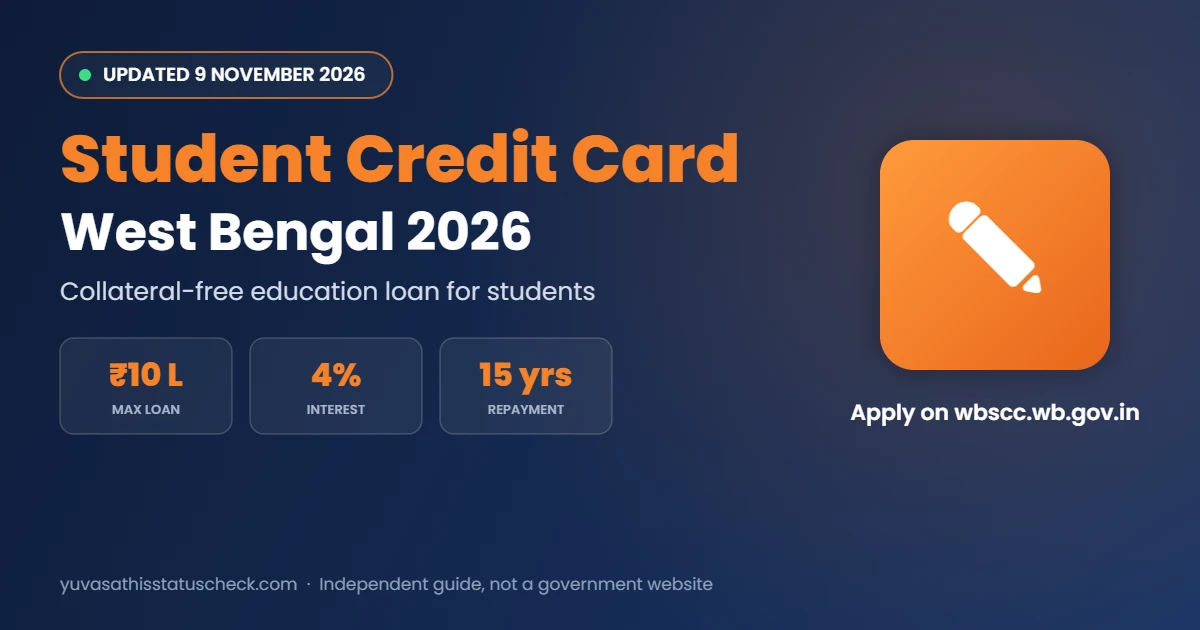
Last checked: 9 November 2026. The West Bengal Student Credit Card is a state-backed education loan that lets students borrow up to ₹10 lakh at about 4% simple interest, without collateral. It can be used for school, college, university, professional and research courses in India or abroad.
This guide explains how the Student Credit Card works in 2026, who can apply, what the loan covers, the interest and repayment rules, documents, the online process on wbscc.wb.gov.in, status check and sample EMIs.
Quick answer: Under the West Bengal Student Credit Card scheme, students who have lived in the state for at least 10 years and are 40 or younger can get an education loan of up to ₹10 lakh at about 4% simple interest, with no collateral and a repayment period of up to 15 years. Apply on wbscc.wb.gov.in with a parent or guardian as co-borrower. The state’s official scheme page was updated on 26 June 2026 and still lists the scheme.
Student Credit Card at a glance
| Point | Details |
|---|---|
| Scheme | West Bengal Student Credit Card (WBSCC) |
| Launched | 30 June 2021 |
| Loan limit | Up to ₹10 lakh |
| Interest | About 4% simple interest a year |
| Concession | 1% interest concession for timely repayment, as per scheme rules |
| Collateral | Not required |
| Moratorium | Course period plus 1 year |
| Repayment | Up to 15 years |
| Age limit | 40 years at the time of application |
| Residence | At least 10 years in West Bengal |
| Portal | wbscc.wb.gov.in |
What is the West Bengal Student Credit Card?
It is an education loan scheme backed by the state government. Unlike a normal bank education loan, the state supports the loan with a guarantee and subsidises the interest, so students from ordinary families can study without selling property or finding a guarantor. The money can pay for fees, hostel, books, a laptop and other study costs. The scheme is run by the Higher Education Department, which checks applications before sending them to banks. Because the interest is low and no property has to be pledged, it has become popular with first-generation college students, students from rural areas and those joining professional courses such as engineering, medicine and nursing.
The scheme was launched on 30 June 2021. By late November 2025, the government said more than one lakh loan cases had been sanctioned. After the change of government in May 2026, we have not found any official notice closing the Student Credit Card; the state’s scheme page was updated in June 2026 and still describes it. Always check the portal for the latest status before you apply.
Who can apply for the Student Credit Card?
- You must have lived in West Bengal for at least 10 years.
- You must be 40 years old or younger when you apply.
- You must have passed Class IX or be studying at Class X level or above (Madhyamik or equivalent stage).
- You must be admitted to a recognised school, college, university or institution in India or abroad.
- The course must be a regular course; distance and online courses are generally excluded.
- A parent or legal guardian must join as co-borrower.
- Neither you nor the co-borrower should be a defaulter on any bank loan.
- A student can hold only one card under the scheme.
Role of the co-borrower
Every Student Credit Card loan needs a co-borrower, usually a parent or legal guardian. The co-borrower signs the loan papers with the student and shares the responsibility to repay. Banks check the co-borrower’s identity, address and income, and they also check that the co-borrower has no unpaid loans. If a parent has passed away, a legal guardian or another close family member may be accepted, depending on the bank. Choose a co-borrower who can support repayment if the student takes time to find a job after the course.
Using the Student Credit Card to study abroad
Students who get admission to a recognised foreign university can also apply. The portal asks you to choose “abroad” as the institution location at registration. You will need the admission letter, the cost of the course and living expenses in writing, and your passport. Disbursement for foreign study usually goes directly to the university for fees, with living costs released in parts. The ₹10 lakh limit still applies, so many students combine it with savings or a scholarship.
Courses covered
The Student Credit Card can be used for a wide range of studies:
| Level | Examples |
|---|---|
| School | Class XI and XII (higher secondary) |
| Undergraduate | B.A., B.Sc., B.Com., B.Tech., MBBS, nursing, pharmacy |
| Postgraduate | M.A., M.Sc., M.Com., M.Tech., MBA, MD, MS |
| Professional and technical | Diploma, polytechnic, law, hotel management |
| Research | M.Phil, PhD, post-doctoral work |
| Abroad | Recognised courses at foreign institutions |
Coaching for competitive exams was also listed in the original scheme for some exams. Check the portal for the current list of eligible courses before applying.
Loan amount and what it covers
You can get up to ₹10 lakh in total. The loan can cover:
- Tuition and course fees.
- Hostel and mess charges.
- Books, stationery and study materials.
- A laptop or computer needed for the course.
- Exam, library and lab fees.
- Travel and living costs for studies abroad, as allowed.
No margin money is needed for loans up to ₹4 lakh. For higher amounts, the bank may ask the family to pay a small share, as per its rules.
Student Credit Card interest rate and concession
The loan carries about 4% simple interest a year, which is much lower than most bank education loans. The state government bears the rest of the interest. If you repay on time, including any interest during the moratorium, the scheme allows a further 1% concession. This makes the effective cost very low compared to private loans.
Moratorium and repayment
- Moratorium: You do not need to start repaying the principal until the course ends plus one year.
- Repayment period: Up to 15 years after the moratorium.
- Early repayment: Usually allowed without penalty; check with your bank.
- Missed payments: Can lead to loss of the interest concession and a poor credit record.
Sample EMIs at 4% interest
| Loan | Repayment period | Approximate EMI | Approximate total interest |
|---|---|---|---|
| ₹2 lakh | 5 years | ₹3,683 a month | ₹21,000 |
| ₹5 lakh | 10 years | ₹5,062 a month | ₹1.07 lakh |
| ₹10 lakh | 15 years | ₹7,397 a month | ₹3.31 lakh |
These figures use a standard monthly EMI at 4% and are for illustration only. Your bank’s actual schedule may differ, especially if interest during the moratorium is added.
Documents needed for the Student Credit Card
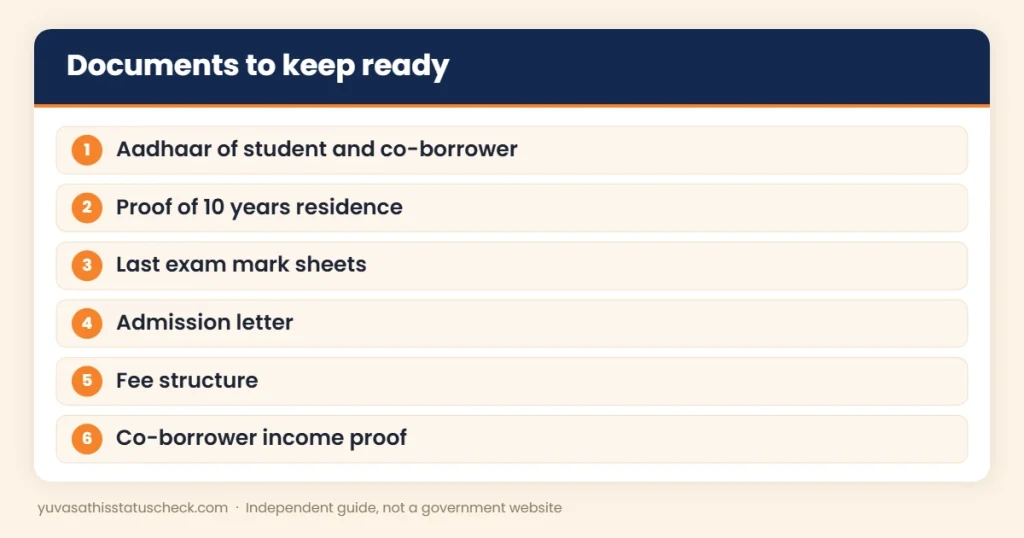
- Passport-size photos of the student and co-borrower.
- Aadhaar card of the student and co-borrower.
- Proof of age (Madhyamik admit card or birth certificate).
- Proof of 10 years’ residence in West Bengal.
- Mark sheets of the last qualifying exams.
- Admission letter or receipt from the institution.
- Fee structure or prospectus showing the course cost.
- Income proof of the co-borrower.
- Bank account details of the student.
If you need a residence or income certificate, read our residential certificate guide and income certificate guide.
How to apply for the Student Credit Card online
- Visit the official portal, wbscc.wb.gov.in.
- Click on student registration and choose whether your institution is in India or abroad.
- Enter your personal, academic and co-borrower details.
- Verify your mobile number with an OTP and create your login.
- Log in and fill in the full loan application with course and cost details.
- Upload the required documents.
- Submit the application and note your Application ID.
What happens after you apply
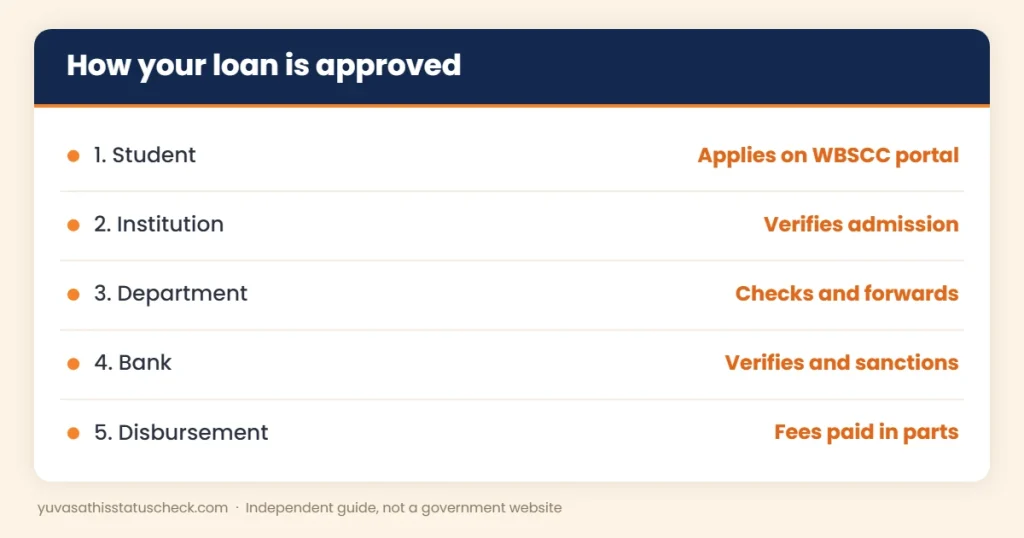
| Stage | Who acts | What happens |
|---|---|---|
| 1. Institution | Head of your institution | Verifies admission and course details |
| 2. Department | Higher Education Department | Checks eligibility and forwards to a bank |
| 3. Bank | Selected bank branch | Verifies documents, may call you and the co-borrower |
| 4. Sanction | Bank | Sanctions the loan amount |
| 5. Disbursement | Bank | Pays fees to the institution and other costs to the student, in parts |
Respond quickly to any call or message from the bank, and visit the branch when asked with original documents.
How the money is released
The loan is not paid in one go. Banks usually release it in parts:
- Fees are paid directly to the institution, semester by semester or year by year.
- Hostel charges may be paid to the hostel or the institution.
- Amounts for books, a laptop or living costs may be paid to the student against bills or as per the sanction.
Keep every bill and receipt, because the bank can ask for proof of how the money was used before the next release.
Choosing a bank
After the department verifies your application, it is forwarded to a participating bank, often one near your home or institution. Public sector banks, private banks and cooperative banks have taken part in the scheme. If you have a choice, pick a branch you can visit easily, as you may need to go there several times during the course. Keep your savings account in the same bank if possible, so that EMIs can be paid by auto-debit later.
Costs to include in your loan request
- Total tuition fees for the full course, not just the first year.
- Hostel and mess charges.
- Books, stationery and course material.
- A laptop if the course needs one.
- Exam, registration and library fees.
- Travel costs for courses far from home or abroad.
Ask the institution for a written fee structure, as banks rely on it to fix the loan amount.
What if you cannot repay on time?
If you have trouble paying after the moratorium, contact the bank early. Banks may agree to restructure the loan or give extra time in genuine cases, such as job loss or illness. Ignoring the bank leads to penalties, loss of the interest concession and a poor credit score, which can affect future loans for both the student and the co-borrower. Keep the bank informed if your address or phone number changes after the course.
Student Credit Card status check
- Go to the WBSCC portal and log in with your Student ID and password.
- Enter the captcha.
- Click “Track Application” to see the current stage.
- If the application is returned, read the remark, correct the details and resubmit.
An example of how the loan works
Suppose a student from Bankura gets admission to a four-year B.Tech course in Kolkata. The fees are about ₹1 lakh a year and hostel costs about ₹60,000 a year. The student applies for a Student Credit Card loan of about ₹6.4 lakh to cover four years. The bank pays the fees to the college each year and the hostel charges as they fall due. After the course ends, the student gets one more year before repayment starts, and then pays a monthly EMI over up to 15 years. If the student pays interest on time, the 1% concession lowers the cost further.
Things banks usually check
- That the admission is real and the institution is recognised.
- That the fee structure matches the amount asked for.
- The identity and address of the student and co-borrower.
- The co-borrower’s loan history in credit records.
- That the student has not taken another loan under the same scheme.
Having all papers ready in one folder makes this stage much faster.
Using the card for Class XI and XII
The scheme also covers school-level study, so students in Class XI and XII can use the Student Credit Card for fees, books and other costs linked to their studies, as listed on the portal. Most families use it for costlier courses after Class XII, but it is worth checking if a higher secondary student needs support for a residential school or a science stream with high costs.
Student Credit Card vs regular education loan
| Point | Student Credit Card | Regular bank education loan |
|---|---|---|
| Interest | About 4% simple | Usually much higher |
| Collateral | Not required up to ₹10 lakh | Often required above a set limit |
| Guarantee | State-backed | Usually needs a guarantor |
| Moratorium | Course plus 1 year | Course plus 6 to 12 months, as per bank |
| Repayment | Up to 15 years | Varies by bank |
If you are eligible, the state card is usually far cheaper than a normal loan. Even so, compare the final terms in your sanction letter, including any processing fee, insurance or charges the bank adds, before you sign.
Combine it with scholarships
A loan is money you must repay, so first check scholarships that do not need repayment. Meritorious students should look at the SVMCM scholarship, minority students at the Aikyashree scholarship, and SC, ST and OBC students at the Oasis scholarship. You can then use the Student Credit Card only for the remaining costs.
Common problems and fixes
| Problem | What to do |
|---|---|
| Application stuck at institution level | Ask your college’s scholarship or loan cell to verify it |
| Returned by department | Correct the details mentioned in the remark and resubmit |
| Bank asking for collateral | Remind the branch that the scheme is collateral-free up to ₹10 lakh and contact the helpline |
| Age above 40 | Not eligible under the scheme |
| Distance course | Generally not covered |
Tips before you apply
- Borrow only what you need; you will repay it.
- Keep all fee receipts and admission papers ready in PDF form.
- Make sure the co-borrower has no unpaid loans.
- Check the course is recognised and listed on the portal.
- Keep your mobile number and email active for updates from the bank.
Helpline
| Channel | Details |
|---|---|
| Toll-free helpline (listed for the scheme) | 1800-102-8014 |
| Email (listed for the scheme) | [email protected] |
| Portal | wbscc.wb.gov.in |
Check the portal’s contact page for any change in numbers.
Frequently asked questions
What is the maximum loan under the Student Credit Card?
Up to ₹10 lakh.
What is the interest rate?
About 4% simple interest a year, with a further 1% concession for timely repayment, as per scheme rules.
Is collateral needed?
No. The loan is collateral-free and backed by the state.
What is the age limit for the Student Credit Card?
The applicant should be 40 years old or younger at the time of applying.
Can I use it to study abroad?
Yes. Recognised courses abroad are covered.
When do I start repaying?
After the moratorium, which is the course period plus one year. Repayment can run for up to 15 years.
Is the West Bengal Student Credit Card still available in 2026?
The state’s official scheme page was updated in June 2026 and still lists the scheme. Check the portal for the latest status.
Who can be the co-borrower for the Student Credit Card?
Usually a parent or legal guardian. The bank checks the co-borrower’s identity, income and loan history.
Can I hold two Student Credit Card loans?
No. Only one card is allowed per student under the scheme.
How do I check my Student Credit Card status?
Log in to wbscc.wb.gov.in with your Student ID and password and use Track Application.
Sources we checked
- West Bengal government scheme page: Student Credit Card: limits, interest, moratorium, eligibility and process (updated 26 June 2026).
- Careers360 / PTI, 28 November 2025: over one lakh loans sanctioned.
- SarkariYojana: WB Student Credit Card Scheme: application and status steps.
Disclaimer: yuvasathisstatuscheck.com is an independent information website. It is not connected with the Government of West Bengal or any bank. This is not financial advice; confirm terms with the portal and your bank before borrowing.